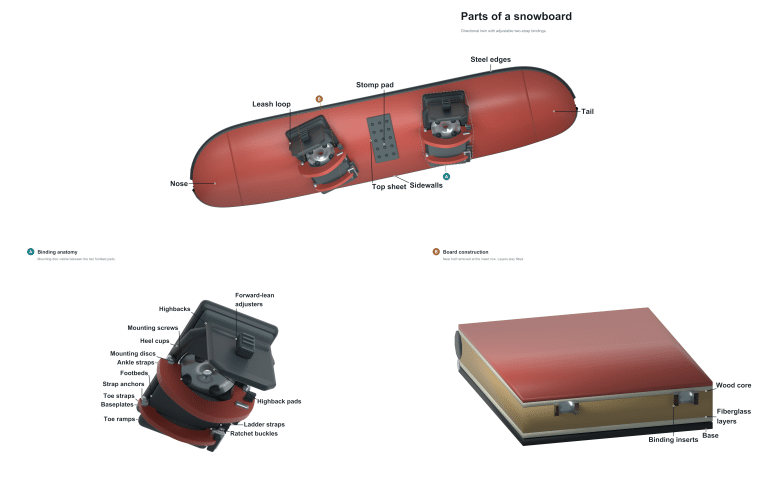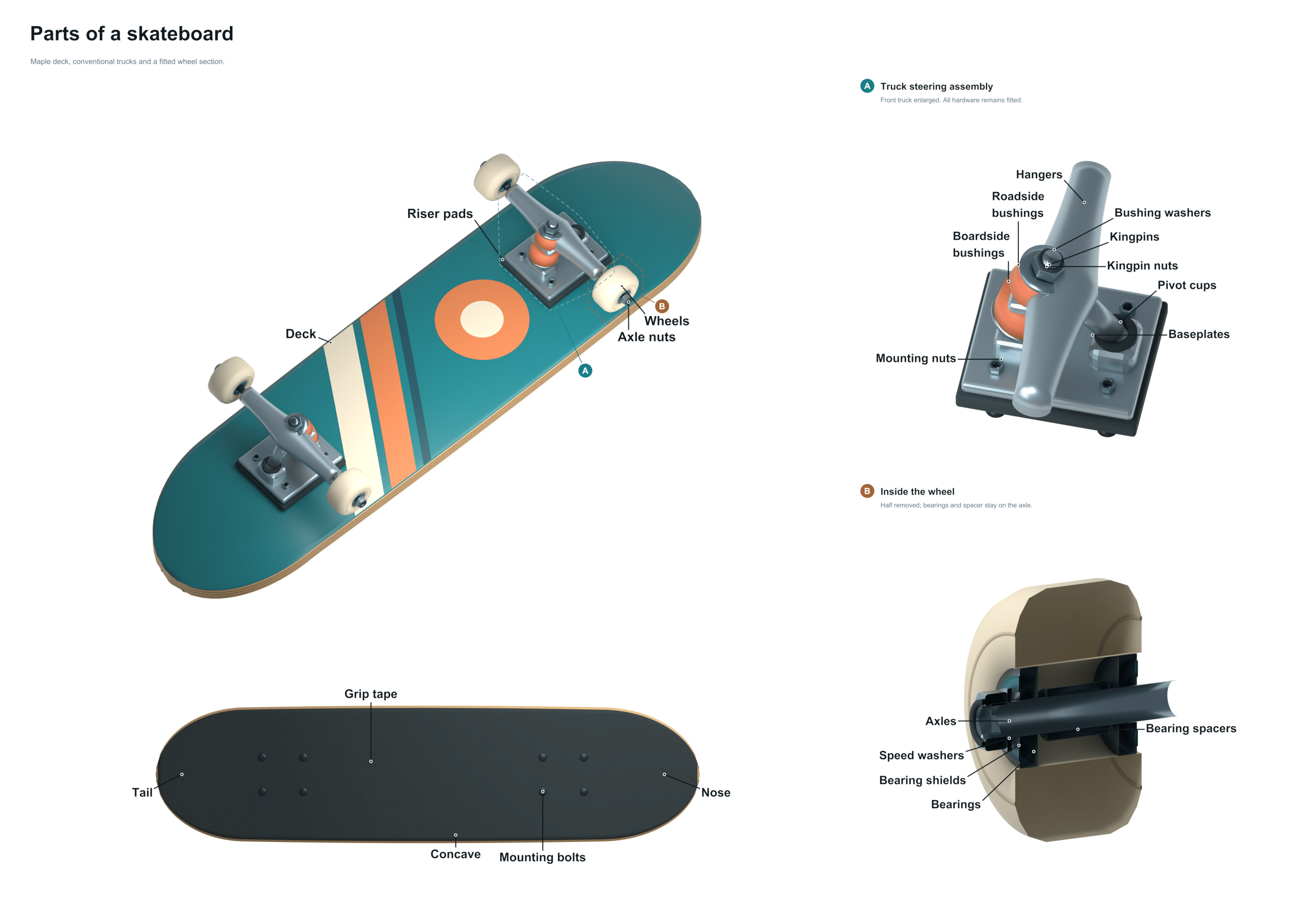
Skateboards are carefully balanced combination of various parts. Together, these component give the rider control, balance and even enable them to pull off tricks. A skateboard is not only a vehicle but also a piece of fitness equipment and a means of transport for recreation. Knowing how your skateboard is constructed will help you care for it properly. And knowing the parts will make you a more confident skateboarder.
Check out the labeled drawing above. As you read through this article, follow along the individual pieces. Using this image as a reference will make all that geeky stuff easier to grasp.
The Parts of a Skateboard
Nose
The nose is the front tip of the deck. It is normaly a bit taller than the tail. This design give you control over the board when it’s jumping and turning sharply. Often times, you’ll notice that the nose curves up. Curving the nose make it easy to get the front of the board off the ground. It is important for ollie tricks. It is also useful for crossing rough terrain without catching the board on the ground.
Tail
The tail is the rear end of the deck, and it looks like the nose. Usually it’s shaped to allow the board to be popped upwards for tricks. As you stomp on the tail the board will snap back down. This gives you the lift you need for jumping and flipping. The height and shape of the tail determine how responsive the board is under your back foot.
Deck
The deck is the main platform where you place your feet. Most commonly, decks are crafted from layered maple wood, which can endures the force of jumping and landing. Length and width are two very important considerations for a board’s deck. Depending on the length and width, you will feel more or less stable and comfortable while riding. Selecting a deck based off your riding style and foot size will ensure maximum control.
Grip Tape
The deck has a textured material stuck on the top. That’s what they call “grip tape.” It helps your shoes grab on so you don’t slip while you ride or perform tricks. As time goes on, the grip tape will wear away. It will be less effective near the nose and tail where you stomp. When it starts feeling too smooth, you know it’s time to replace it. If it gets all dirty and wet and is no longer able to perform its job, replace it.
Hardware / Bolts
The nuts and bolts holding your trucks on the deck are called hardware. The hardware is usually steel, a sturdier metal that stands up to the hardships of riding. Hardware needs to be tightened down sufficiently to stay in place without being loose but not too tight as to resist turning. If hardware is looser than it ought to be the board will feel shaky, riding will become uncertain.
Truck
Steering Mechanism: That’s the metal T-shaped truck that’s mounted underneath the deck. That’s the part that steers the skateboard. By leaning your body weight, the truck lets the board move from side to side. For a nice ride, it’s important that the truck is properly aligned. Also, they will keep you balanced when going faster.
Axle
An axle is a metal rod on either side of the truck. It’s the rod on which the wheels spin freely. How far apart your board sits depends upon the size of the axle. If it’s very long then in a hard turn it could possibly cause the wheels to touch the deck and you will lose control.
Hanger
It is a truck. Trucks consist of a hanger, which the wheels and axle mount on. Trucks also pivot on their kingpins so your board can turn. Typically the hanger is made of aluminum or steel. They needs to be strong enough to withstand impact. Any bends or cracks in the hanger are cause for immediate action. No accidents here.
Kingpin
The big middle bolt is the kingpin, the center of the truck. This is what the entire truck revolves around. The more you tighten down the kingpin, the less it will turn. The more you loosen the kingpin, the more it will turn and allow for a sharper turn.
The urethane cylinder/cone on each side of the kingpin, known as a bushing, creates resistance when turning. The softer your bushings, the easier it turn. This is perfect for cruising. The harder your bushings, the more stable they will be at high speed. That’s good for tech street skating.
Baseplate
A flat plate that rests directly on top of the deck, known as the baseplate, gives all other parts of the truck assembly something to mount to. Force from your landing is distributed throughout the deck by the baseplate. This keeps the truck even and secure on the board.
Riser Pad
The base plate can be attached directly on the deck or with a riser pad which stands between the deck and baseplate. The purpose of a riser pad is to raise your truck up so it’s not as close to the board, avoiding what they call “wheel bite”. When you make sharp turns, your wheels might hit the deck. The other benefit is that it helps soften the bumps on rough water making for a smoother ride.
The polyurethane circles on the bottom of your skateboard that roll along the ground are called wheels. Diameter and hardness dictate speed. How well you grip the surface is dictated by the wheel too. If you want to cruise around on rough pavement, bigger softer wheels work best. If you want to do tricks on a smooth skatepark surface, small hard wheels is ideal.
Wheels
The little metal parts within the wheel itself let the wheels roll smoothly without much resistance or friction. Having clean bearings is important if you want your board to go fast and stay efficient. Sometimes when your board slows down it means your bearings should of been cleaned up. Sometimes the wheels will sound like they’re grinding when you turn them, which means it’s time to change out the bearings.
To conclude. Together, all these components make for a solid and responsive skateboard. To help keep your ride working well, always check that all hardware is tightened properly. Examine your bushings and make sure they aren’t worn down. Keep your bearings clean. Taking care of everything will get the best performance from your board while keeping you safe during each ride.