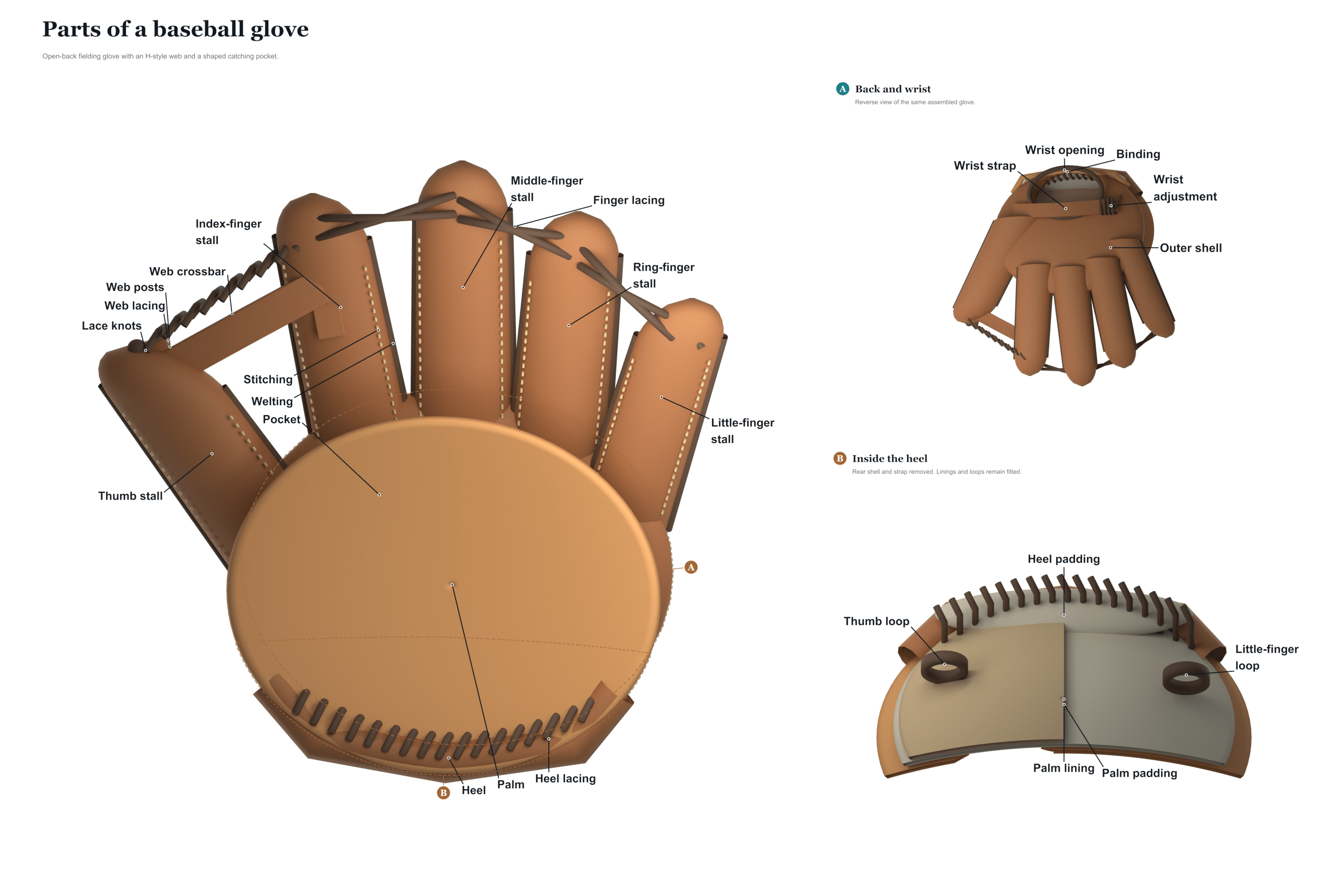
Your baseball glove is a tool specially made for catching a ball quickly while protecting your hands. The glove is designed with specific parts that make the glove last and perform well. Knowing what those pieces are will enable you to care for the glove and know when it requires some maintenance. Let’s take a look at the labeled diagram above and find each piece, then discuss how they work.
Where does your hand go? It is the wrist opening. There should be a nice fit around your wrist so that when you are playing, it doesn’t slip off. This section is reinforced and can handles the stress of catching throws. Too loose here and the glove moves on your hand, you lose control.
Parts of a Baseball Glove
Wrist strap
The wrist strap is attached right at the opening. The wrist strap has an adjustable band that cinches down snugly on your arm. Tighten it up or loosen it depending on how tight you like it. It will keep the glove in place and take some of the impact force off your hand when you dive on a ball.
Palm
Next up is the palm. This part of the glove is usually a thick and strong piece of leather that holds most of the rest of the glove together. It acts as a buffer between your hand and the field and it’s where most of the action take place. Because this area will break-in and conform to the shape of your hands over time, you’ll notice some stretching on the palm.
The pocket is the deep indentation where the ball lands once caught by the glove. The better formed the pocket, the more secure the ball will be trapped and less likely to pop back out. Fielders frequently spend time shaping the pocket to fit their playing style. Outfielders sometimes like them shallow with a bigger surface area while infielders typically want them deeper to help quick transfer.
Laces
The laces connect all parts of the glove. The laces are strips of leather that tie all the pieces of the glove together. They not only hold the glove in place but also let you adjust the tension. A snapped lace will cause the glove to be unstable and loose. Laces take a lot of abuse with each catch so it’s important to regularly check them.
Heel
The heel is located at the bottom of the hand. It is the part of the glove that curves around your wrist to form the lower part. It gives the glove structure and shape. Since we’re talking about catching baseballs repeatedly on this part of the glove, it needs to be strong enough to withstand the beating. When the heel wears out or breaks, the glove will begin to lose its shape and may not fit comfortabley anymore.
Fingers
The fingers rise from the palm and heel. They are long and padded to help guide the ball into the pocket as well as to protect your hand. Depending on the glove’s position, the fingers will also be different in length and stiffness. Outfield gloves tend to have longer fingers which give a greater surface area to catch the ball with. Infield gloves generally has shorter fingers so you can get the ball out of there faster.
Index finger stall
The index finger stall gets special attention. Your index finger goes in here. Because the index finger is used to guide the ball into the pocket, it’s often reinforced. You want a stall that protects but still allows for natural movement. Getting this stall aligned properly facilitates good accurate catches.
Pinky stall
The pinky stall is on the opposite end. For those of you who are unfamiliar, this refers to your pinky finger. When paired with the other finger stalls, it forms one continuous barrier that protects from impact. When you make a catch, the pinky stall assists in stabilizing the glove. If the pinky stall gets loose, you might notice an imbalance in how the glove fits in your hand.
Web
The web connects your index finger to your thumb. It’s that mesh (or leather) web connecting those two fingers. By not letting the ball slip in-between them, the web traps the ball there. There are different types of webs which provide more or less ball retention and visibility. An open web provides more visibility while a closed web is good at concealing the ball from the batter.
Thumb
The thumb completes the structure. It’s a small rounded piece that will help direct the ball into the pocket as well as protect your thumb from injury. Attached to both the web and the palm, it needs to be pliable so that when you grasp the ball in your hand, the thumb can fold over. Having an inflexible thumb can prevent you from securing the catch quickly.
This combination of components makes this a good catching tool. The pocket, the web, and laces keep everything intact. They control the ball. The shape and protection are provided by the heel, stalls, and fingers.
If you feel like something isn’t right with your glove, make sure the pocket hasn’t gotten out of shape, that the wrist strap is locked down, and that you check the laces for tension. Maintaining each piece will help the glove be reliable all season long. Knowing what each component is and how they all work together will help you take better care of your gear.
A baseball glove is a combination of stiff components and flexible ones that combine to make a single unit. Notice where your glove flexes while in action. Where do certain pieces shift? Address those things sooner than later so you get more use out of your glove and keep it in the best condition possible.
Use this drawing as a guide for knowing where these are on your own glove. Tuck it away next time you’re inspecting yours for wear and tear. A good glove is one that’s been tended to with great care, piece by piece. You should of checked it sooner.