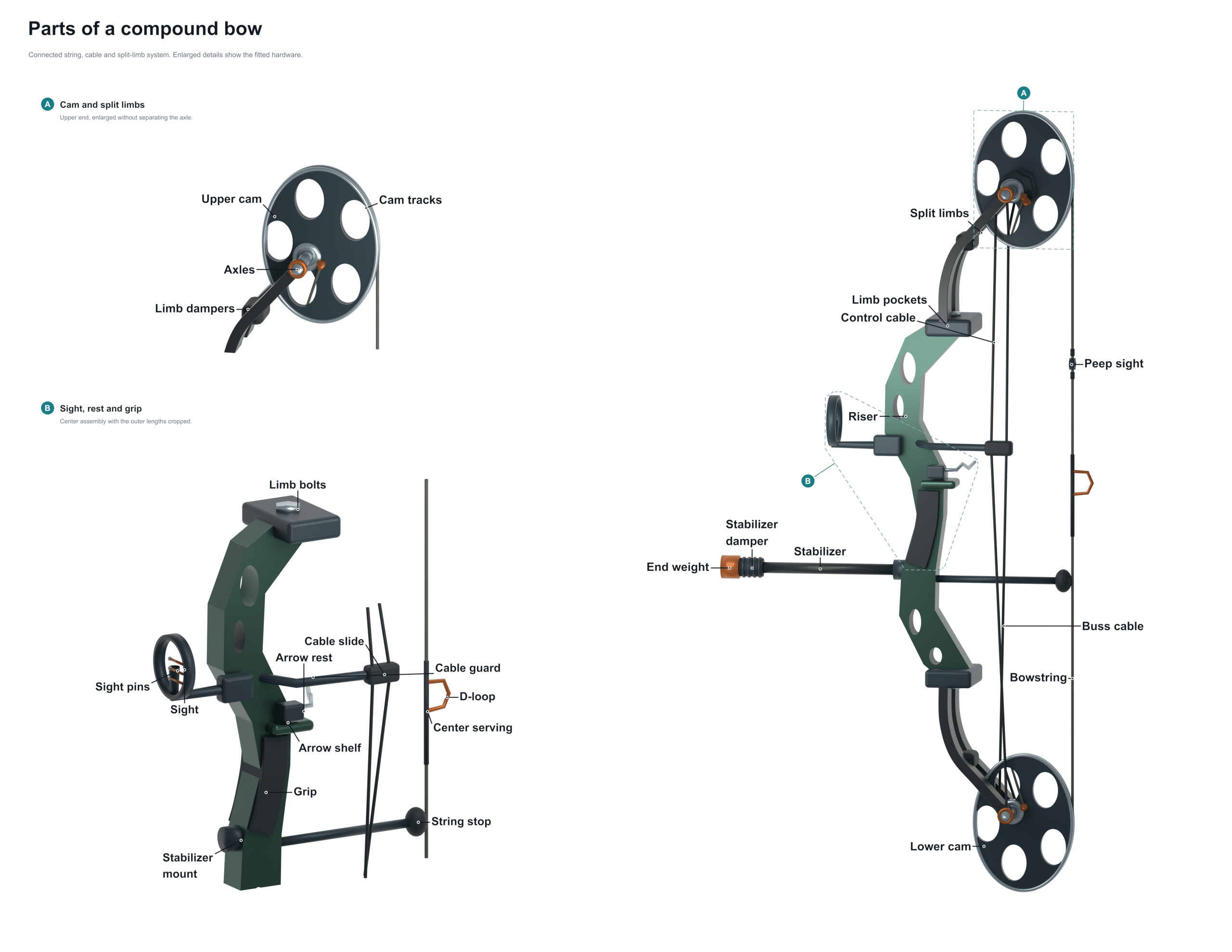
A compound bow is a mechanical device that helps an archer shoot with more power and accuracy then traditional bows. The pulleys and cables allows for efficient storage of energy. They also feature a let-off which reduces the strain on your arms while they are held at full draw. Each part of a compound bow has a label as shown in the diagram above. Below is a description of what the parts are and how they work within the bow.
The riser is the backbone of the bow and its central handle. Everything else attaches to it. Typically, risers is constructed out of composite materials or aluminum to ensure they are not too heavy while remaining strong enough. How the bow feel in your hands depends on the design. Grip… This refers to the section of the riser that you grasp when holding the bow. It will be molded to fit your hand comfortabley. A good grip provides a steady hold which improves your accuracy. Every little variation in your grip alters the flight of the arrow.
Parts of a Compound Bow
Sling / wrist strap
A wrist strap or sling holds the bow to keep you from losing it. It wraps either your hand or wrist. It’s basically an added security device used as you move across different types of terrain. Attached to the front of the riser is a rod called the stabilizer. It dampens vibration and weighs down on the bow. When aiming it also reduces shake and helps with the balance of the bow. The weight and length can be adjusted to match whatever your preference in balance might be.
Sight
The adjustable device on the riser is called a sight. It’s used to aim at what you want to hit. It has pins for different distances and allows you to compensate for arrow drop. For consistent shots, it’s critical that you align properly with your eye and the arrow. The sight contains pins that allow you to compensate for arrow drop. The peep sight is a little circle that attaches to the bow string and lines up with the sight pin. This makes sure that your eye is positioned the same way for every shot. Rotating the peep sight up and down adjusts for the height of your eyes.
Riser
The arrow rest holds the arrow in place prior to shooting. It centers the arrow on the riser. It also allows the arrow to clear the bow smoothly when released. You’ll be able to adjust its position and height to match your arrow set-up. Quiver mount is a bracket on the riser that holds your arrow quiver. Quivers hold your arrows. They stay handy but also out of the way when moving around. Place them properly on the bow so they do not get in the way of your sighting.
Upper limb
From the top of the riser, there are two flexible arms called the upper limb and the lower limb. When you draw the bow it will bend allowing for potential energy to propel the arrow. How long the limb is and what material it’s made out of determines how fast and powerful it can be. The lower limb is a mirror image of the upper limb coming from the bottom of the riser. Working with the upper limb, it too stores energy. It is important that both limbs is of equal tension so that the bow functions properly.
Limb pocket
Limb pocket. This is a housing on the riser where your limbs attach. It holds your limbs in place. It lets you adjust draw weight precisely. Set the tension by tightening the screws according to manufacturer’s directions. The axle is the pin that goes through the end of each limb. It connects the limbs to the cams. It allows the limbs to pivot when drawing back on the bow. Make sure you lubricate your axle so it operates smoothly and doesn’t wear out.
Top cam
The wheel is at the end of the upper limb and is the top cam in a compound bow. This wheel manages the cables and the bow string. This also helps with the mechanical advantage, which makes for less holding weight on full draw. How smooth your shot is and how fast it comes off depend on this design as well. Lower Limb, The bottom cam sits at the end of the lower limb. This one is synced with the top cam. It is a mirror image of what the top cam does. For a bow to work properly both cams needs to be on time.
These are called cams, which are the pulleys that make up this system. The compound bow would not function without them. They take the archers’ pull and store it within the limbs as energy. Knowing how the cables react to the cams is a big part of maintaining your compound bow. The channel is also known as the cable groove. This is what runs up the cam to guide the cable or bowstring. It keeps your strings and cables tracking properly throughout the draw cycle. These channels is also good to check for any type of damage that might cause uneven performance.
Bowstring
Bowstring is the rope that holds the arrow nock and transfers energy from the limbs to the arrow. The bowstring is the rope that holds the arrow nock. It’s responsible for transferring limb energy to the arrow. It should always be checked for any signs of fraying as it will become very stressed. If you’ve got a bad string that has been worn down, not only could it break but cause serious damage to your gear or yourself. This is a cable. Connecting one cam to another, the cable helps in transferring energy throughout the system. It also works with the bowstring to produce let-off. To keep from wearing out too soon, the cables need to be cleaned and oiled. Cables must be kept clean and lubricated to prevent premature wear.
Cable guard
This is the Cable Guard. The cable guard protects the cables from the riser and limbs by either covering them or routing them along a channel. By keeping the cables on track through the draw cycle, it ensures the cables follow the proper path. It keeps friction and possible damage away from the cables. Cable Slide A piece added to the bowstring, the cable slide facilitates the smooth movement of the cables through the shot. It balances the forces of the string at full draw. Maintained properly, it operates quietly and efficienty.
Nocking point
D-loop is a small loop of string attached to the main bowstring near the nocking point that you use to attach your release aid. A smaller loop tied onto the bowstring, the D-loop provides a spot to which you tie your finger tab or release aid. It makes it easy to adjust the release position on the arrow. A nocking point is the area on your bow string that the arrow nock rests against. The nocking point needs to be positioned correctly so that the arrow launches true. By adjusting your nocking point up and down, you’ll be able to dial in your trajectory.
String stop
Attached to the riser or limb, the string stop is a device that dampens the vibration of the bowstring following the shot. It softens the abrupt stop of the string. Doing so lessens the hand shock and noise while making the experience smoother. It should of been noted that this helps with the feel.