Squeezing the bellows alone only produces a gentle sigh of air, but if you press a key at the same time, the instrument starts to sing. If you do both together then it’s as if the instrument sing. It’s all mechanical between the two events. Air flows, valves open and steel tongue begin to vibrate creating sound.
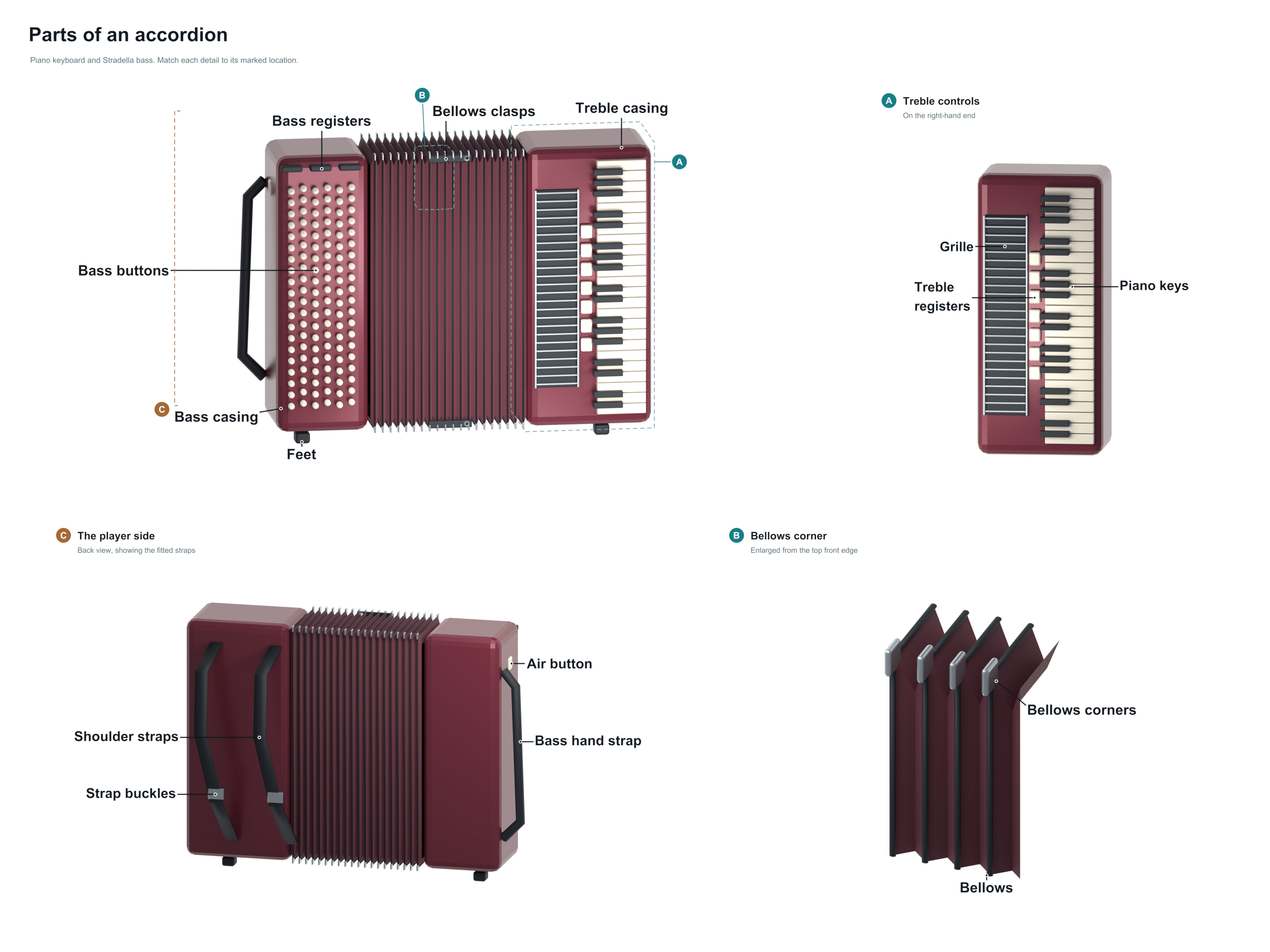
This is a piano accordion with a Stradella bass system. It’s the most familiar picture of an accordion. On one side, you have a keyboard similar to a piano where your right hand play the melody. A grid of buttons on the other end is played by your left hand producing chords and bass notes. Air passes into each side at the same time through the bellows.
What we see does not make the sound. The reeds is hidden inside the casings. The outside is simply a series of controls that direct the flow of air.
The Parts of an Accordion
Piano keys
On the right-hand side of the accordion are the treble keys that your right hand plays. As in a regular piano, the layout is the same so black keys represent flats and sharps while white keys are natural notes. There are 41 keys on a full size accordion and less on student instrument. When you press down on a key it raises a pallet valve which in turn brings the air to the reeds. As long as you continue to push the bellows and keep the key depressed then the note will sound.
Treble registers
Alongside the keyboard are the treble registers. There are several ranks, or sets of reeds for each note. These are either tuned slightly apart or an octave apart. Which ones play depends on the register. The registers decides which of those ranks play together. One gives a bright tone. The other produces a sound called a musette that connects with French café music.
Grille
At the top (treble) end there is a metal grille. This is so that the sound escapes through the gaps. It also stops the keys and pallets being damaged. Do not cover the grille with your sleeve or arm as this will muffle the sound.
Treble casing
Inside the casing at the treble end are the key mechanisms, pallets and reed blocks. The keyboard is attached to the side of this casing. When playing, it sits against your body.
The Stradella System Bass Buttons are on the left hand end. There are two rows of single bass notes played closest to the bellows. Full chords are played from the outer rows with a single press. On a full size instrument there are six rows of 20 buttons making a total of 120. Following the circle of fifths, the columns runs around the instrument. This means common chord changes are close together.
Bass registers
Above the bass buttons are the bass registers. These work in a similar way to the treble registers and select specific reed sets. With one set you get a heavy bass sound. With another you have a lighter tone that can be used for softer melody lines.
Bass casing
Inside the bass casing, you find the bass reeds plus a complex setup of rods and linkages. This enables several pallets to be opened with a single button. It allows for playing a complete chord with just one button being pressed.
Bellows
Lungs are represented by the bellows. These join the two sides of the instrument with pleated chambers. To draw air into the instrument, pull the bellows apart. To blow air out, push the bellows together. Unlike some instruments that only sound in one direction, piano accordions sounds in both directions. You can play with the bellows opening or closing. Control of the bellows brings a lot of the expression to the performance. A steady movement produces a smooth note. A quick movement adds an accent.
Bellows corners
The corners of the bellows pleats are protected by small metal caps. The corners of the bellows pleats tend to be the first part to wear out on an accordion. The metal caps prolong the life of the bellows and stop them splitting.
Bellows clasps
When not in use, the bellows are fastened together. This is done with the bellows clasps. They hold the bellows together while the accordion is stored. Whenever you put the accordion down you should of fasten the bellows. If they go loose they will open and stretch the pleats. You must unfasten the clasps before playing.
On the bass end, you have an air button next to your left thumb. This means that holding it down lets air through without making any sound. This is used by players to quieten the bellows back into place. It can also close the bellows without any noise at the end of a piece.
Bass hand strap
The bass hand strap is on the left end and is quite wide. It runs underneath your left hand. As you push against the strap, it moves the bellows. This means that your fingers can be free to play the buttons. Getting the right tension in the strap is essential. Too loose and controlling the amount of air is hard. Too tight and reaching the outer buttons becomes a problem.
Shoulder straps
Most of the weight is carried by the shoulder straps. These run across both shoulders as if they were a backpack. They hold the treble side firmly against your chest. The bass side is free to move with the bellows.
Strap buckles
Buckles on the straps let you adjust the length. This alters the height of the keyboard. If set correctly, the keys are easily reachable.
Feet
Often players will stand their accordions up. On the bottom of each casing are small pads called feet. They help prevent scratching the finish. They also secure the accordion so it doesn’t slip around. The feet are also designed to hold the full weight.
When you are finished playing, store the accordion in its case. Leave the bellows clasps closed. Do not expose the accordion to heat. Many accordions use wax to fix their reeds to the reed blocks. The wax is softened by heat. Reeds can go out of tune or stop sounding if they become loose.