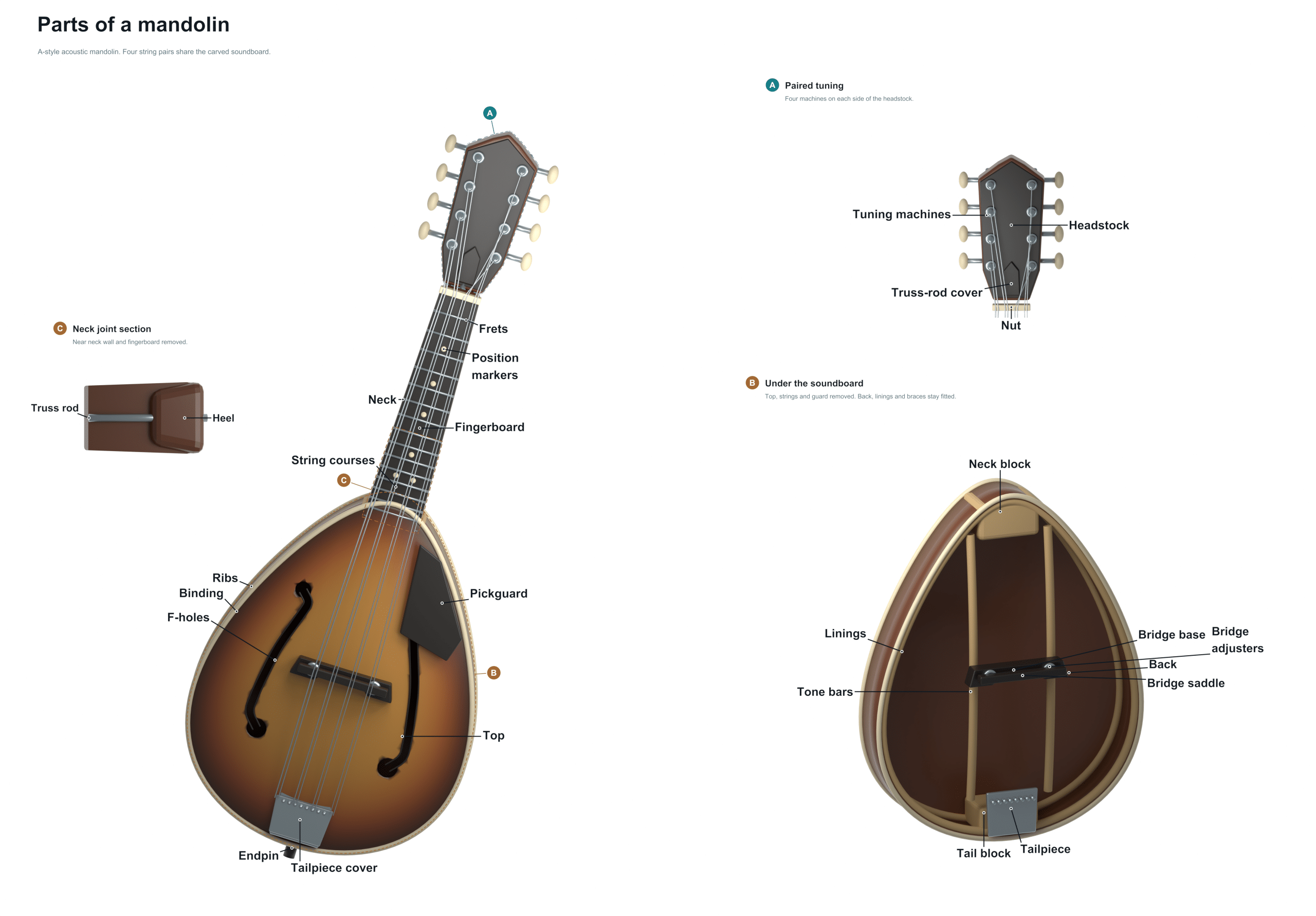
Here is a quick note on the mandolin. With its fast attack and bright tone, the mandolin is used in many genres, including Celtic, Folk, Classical, and Bluegrass music. Knowing how this instrument works, where the parts are, and what they do can help keep your mandolin well maintained. It can also help you understand how sound is created.
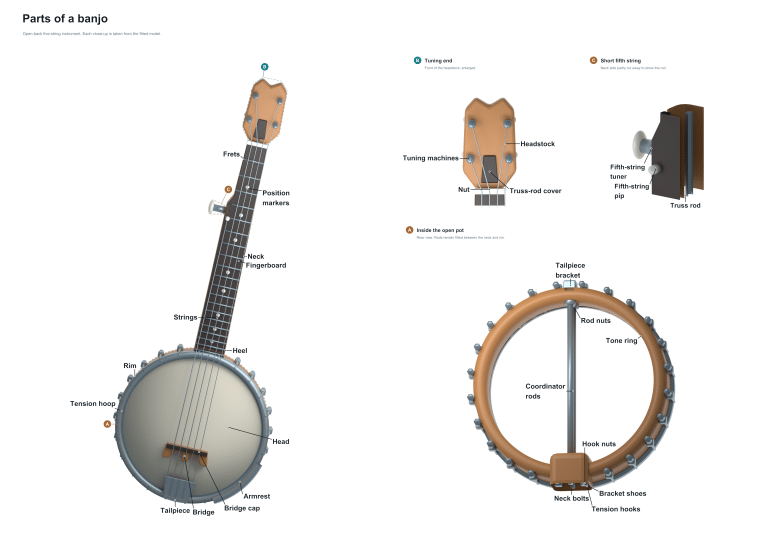
Starting at the top end of the instrument, follow the labelled diagram and use it to find each part as you read about their role. On the headstock, there are tuning pegs that adjust the pitch of the strings. These is turned to tighten or loosen the strings. This increases or decreases the tension. They should of been properly lubricated to allow for smooth adjustment when tuning as well as not slipping during a performance.
Parts of the Mandolin
Headstock
The headstock is the top of the neck where the tuning pegs is located. This is the structural point at which the tension on strings is anchored. It usually has the manufacturer’s logo. Break angle of strings and tuning stability are also determined by the angle at which the headstock sits in relation to the neck.
Strings
The mandolin has four courses of double strings. That’s eight strings altogether and they’re usually tuned in pairs giving it a fuller sound. The strings stretch across the full length of the instrument (from the tailpiece to the tuning pegs). When the strings are strummed or plucked they vibrate which creates the sound.
Neck
Running down the neck just below where the head stock meets the fret board is what we call the nut. This is a small, narrow strip that directs your strings from the tuning pegs to the fret board. It controls the distance between the strings and the string height at the top of the neck. If your nut becomes worn out you may experience problems with tuning or buzzing. Check this every now and again.
Body
From the headstock to the body, the other element of a guitar is the neck. Here we find where the fret board sits, with strings being pressed down as they travel along the neck. Pressing these strings down onto the frets alters the note. A strong stable neck is essential to ensure good intonation and action over time.
Fretboard
On the neck, there’s a surface called the fretboard that’s where your fingers come into contact with the strings. This is typically made from a hard wood such as rosewood or ebony to resist the force of your fingers. On the fretboard are position markers that help you find notes with ease.
Frets
Frets are small pieces of metal wire that have been placed into the fret board at regular intervals. These divide up the neck into sections. By stopping your finger on these frets, you can alter the pitch of a note. Uneven or worn out frets can lead to intonation issues and buzzing. Clear tone depends on clean frets.
The mandolin’s body is essentially its main structure and consists of a large hollow chamber. This connects with the string vibration to amplify it. The type of wood used in the body along with its shape affects the volume, projection and tone color.
This is a hole that is cut in the top of the mandolin’s body. It is typically positioned directly above the bridge. This hole enables air to pass through the instrument and this is vital for producing sound. This is where dust and other debris can gather. Regular cleaning will ensure best sound performance.
A pick guard is a piece of plastic that is glued on to protect the body of the guitar. On an acoustic guitar, it will be located around the bridge area and just under the sound hole. It’s there to protect the finish and avoid any scratching or damaging of the mandolin due to picking. A quick fix to a cracked or loose pick guard can save the wood underneath from being permanently damaged.
Bridge
The bridge is a small piece of wood that sits on the top of the body, directly under the strings. This rests on the top of the body. Its job is to transfer the vibration from the strings into the soundboard. The soundboard in turn vibrates the air within the body. To get the right string height and intonation the bridge needs to be placed accurately.
At the other end, towards the body, there’s a thin piece of material (usually made from plastic or bone) called the saddle that slots into the bridge. This in turn holds the strings up. What this does is determine the final length of the vibrating string. How high the saddle sits and at what angle will affect string action and the clarity of your tone.
Tailpiece
At the base of the instrument’s body is a piece of wood or metal called the tailpiece, which holds the strings in place and also supplies counter tension against the tuning pegs. Certain tailpieces is adjustable for fine-tuning purposes. This can be useful if you need to make very slight pitch adjustments after your initial tuning.
Together all of this creates the mandolin’s unique sound. Energy travels from the bridge into the body which in turn vibrates through the hollow chamber. If you find that your mandolin is sounding dull or even hard to play, take some time to inspect the condition of your strings. Also, examine your neck relief and the position of your bridge. Caring for these elements on a regular basis will ensure your mandolin plays its best.