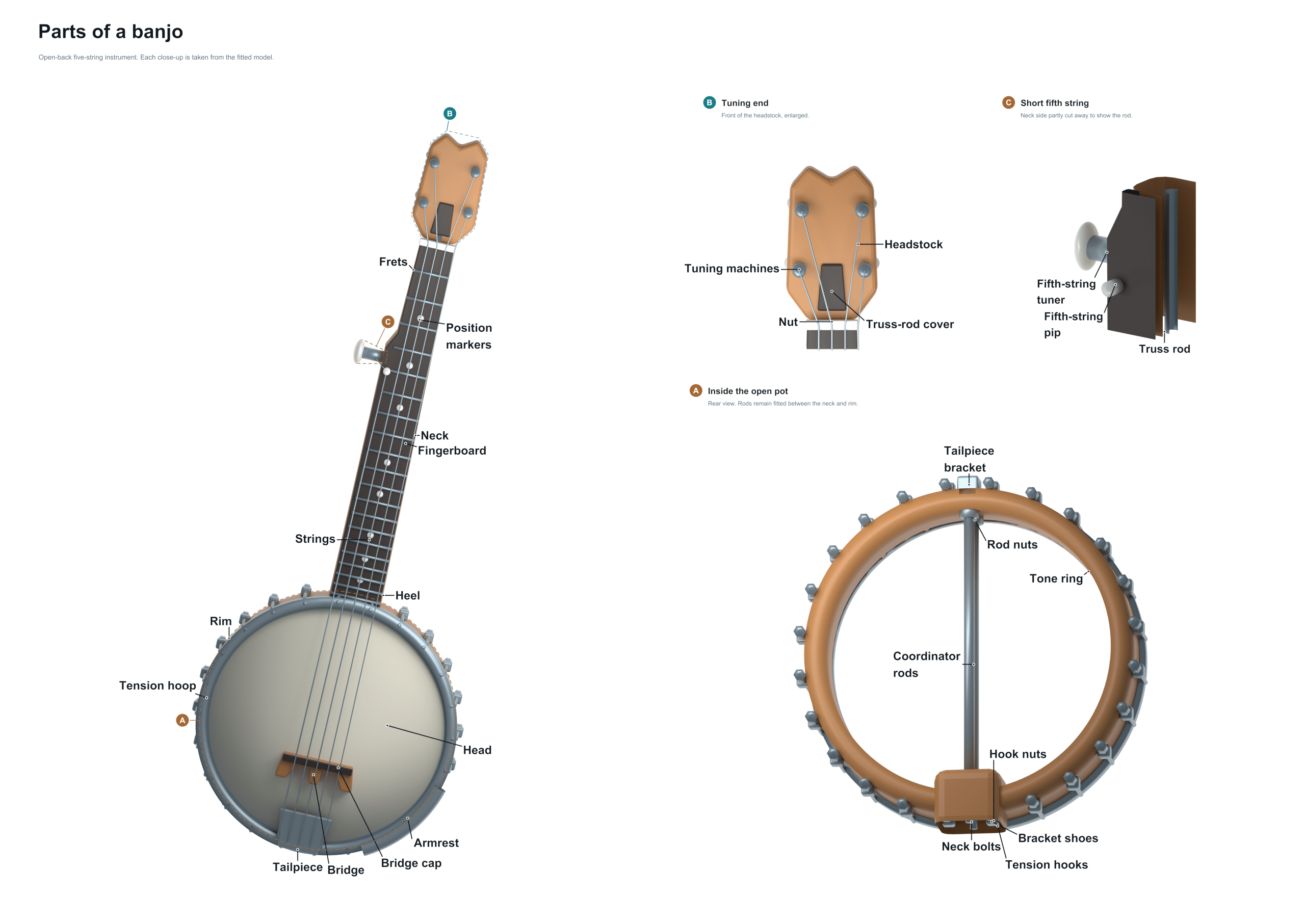
The banjo is a unique sounding stringed instrument with a bright tone that has become synonymous with traditional American music, country, folk, and bluegrass. The banjo is played by either strumming or plucking the strings which cause them to vibrate. This vibration passes over the bridge before sounding against the drum-like body of the instrument. To keep your banjo in good condition and to adapt it to your own personal playing style, it’s useful to know how they is built. Read on and use the diagram above to find each part of the banjo. Each section will be explained along with what it does, beginning at the highest point of the banjo and working downwards.
At the top of the banjo is the headstock. This part of the instrument supports the strings on one end and contains the tuning mechanism. Usually the headstock is angled to provide mechanical advantage for the tuning pegs. It’s frequently carved or inlaid with some design but essentially it’s there for structural support.
Parts of a Banjo
Tuning pegs
The tuning pegs are the gears or keys that tightens or loosens your strings. When you turn the peg, it increases or decreases the string tension. This will raise or lower the pitch. Typically, a five-string banjo has five pegs. These pegs need to be lubricated periodically to allow easy turning and not allow them to slip.
Nut
Here we have the nut. Sometimes made from plastic or bone this small piece of material rests between the headstock and the neck. On it are tiny groves that retain the strings at a fixed distance above the fingerboard. This element controls how high up the neck the string action is. As these grooves becomes worn, the strings will either be too low or begin to buzz.
Frets
Next we have the frets. These are pieces of metal set into the fingerboard at regular intervals. Pressing a string against a fret reduces the length of the vibrating string. This results in a higher pitch being heard. A fret helps you to remain consistently in tune. They can also become worn over time and require replacement for good intonation.
Neck
Neck, This is the long narrow portion of the banjo that extends from the headstock to the body. The neck supports the frets and fingerboard. Typically, the neck is constructed out of wood. In some newer moddern models, the neck can be adjusted. Having a rigid neck is important in ensuring good string tension and alignment.
Fingerboard
The fingerboard is the flat section at the top of the neck where you place your fingers when playing. It is typically made from hardwood and glued directly onto the neck. The fingerboard gives you something smooth to play across. On certain banjos, there may be position markers on the fingerboard so that you can quickly locate the note.
Hooks
Hooks are little metal pieces located on the back side of the neck close to the headstock. You can also take the neck off the pot and have full access to the inside of the instrument. If you want to adjust the head tension, or clean out the inside of the resonator, this is a nice thing. Just unhook it and you can separate the neck assembly.
Strings
The strings are the long, thin flexible cords that make the sound when plucked. On a standard banjo there are five strings, four steel ones and one shorter fifth string. When you pluck the strings they vibrate through the bridge into the head. To maintain good tuning and a bright tone it’s best to change your strings from time to time.
Head
The head is the part across the front of the pot that has a stretched skin or some form of synthetic membrane on top. This works like a drum skin that vibrates to make the strings sound louder. The tone and volume are affected by how tight the head is. A tighter head makes for a louder, brighter sound. A looser head is softer and darker.
Tailpiece
It is a small lightweight piece that fits on top of the head. Between the tailpiece and the neck is where it goes. From the strings to the head, this is what the bridge does. Vibration. For good tone, it needs to sit perpendicular to the strings and flat. It is not glued down. Why is that? So you can adjust tone and intonation.
Its job is to anchor the bottom end of the strings to the banjo. Keeping them under some tension and pulling them off the head. Tailpieces range from simple posts to more complex assemblies with tension rods. Having a solid tailpiece contributes to sustain as well as tuning stability.
Rim
Attached to the rim is a curved piece called the armrest. This is where you are meant to rest your strumming arm. As you can imagine, it’s comfortabley to play with over extended periods of time. For some players, this is their preference for a relaxed posture. For others, they remove it as they prefer a different angle for their hands. It’s not a functional piece but an option for comfort.
Resonator
Attached to the back of the pot is the wooden back plate called the resonator. Its purpose is to reflect the sound forwards giving increased volume and a projection of the tone. Without it, the banjo would be open-backed and have a more mellow, softer sound. The resonator adds projection, which is useful when playing in groups.
Coordinator rod
A metal rod running through the neck connecting it to the rim is called the coordinator rod. This enables you to change the angle of the neck in relation to the body. Turning a nut on the rod will lift or drop the head height. This alters the string action and playability of the instrument.
Rim This is the wooden ring that surrounds the outside of the pot. The head and tension hoop are held to it. Structurally this is the main part of the body. It needs to be able to cope with quite high tensions from the head. The wood used and the thickness of the rim can also affect the tonal character of the instrument.
All these elements combine to make a banjo sound like no other. If something is not right on your banjo, it could of be that the head is too loose or the strings are not tightened enough, or perhaps the bridge is out of place. Keeping everything in working order ensures your banjo sounds good and stays well maintained. Knowing what each component does will allow you to take better care of your instrument. When you understand how they does their job, you’ll play with confidence.