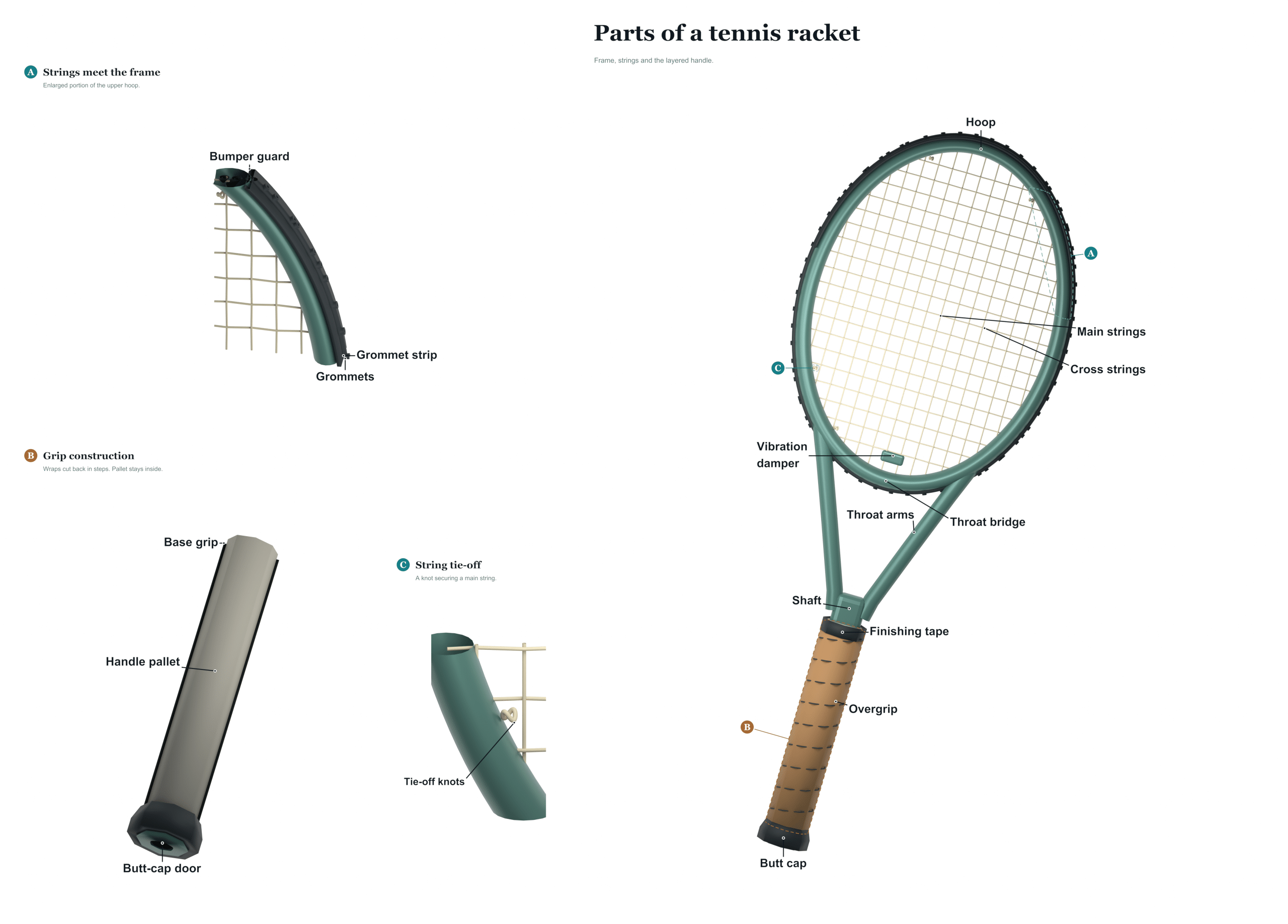
Beyond a stick with some strings, a tennis racket is an instrument of precision. It’s meant to take energy from your arm and put it on the ball. This design lead to accuracy and control.
Knowing the racket’s anatomy will not only help you keep it in better shape but will also allow you to speak more clearly with your stringer. It allows you to understand problems if your game isn’t feeling right.
Parts of a Tennis Racket
Below is a breakdown of the equipment. Learning the parts helps you get familiar with them. This provides you with a clearer picture of how they work together as a tool. You understand how each part adds up to the overall function of your shot.
Head
The head is the top section of the racket that holds the string bed. This is the biggest section of the frame and is what dictates the size of the hitting area. In terms of size for most moddern rackets today, this can vary from oversized to midplus. This will influence both control and power. Generally speaking, the bigger the head, the greater the power and bigger the sweet spot. Conversely, a smaller head provides more precision. Depending on if the head is oval or teardrop, the shape will affect the feel of the racket in your hand as well as how the ball will react upon impact.
Bumper Guard
This is a bumper guard. The bumper guard is simply a thin piece of plastic lining the inside curve of the frame. The main function here is to prevent damage to your frame. Dragging your racket on the court or accidentally bumping it against something happens all the time. If left unchecked, this can lead to cracking and chipping of the composite or graphite material used to make the frames. As you’ll find, this layer can be replaced. So when you begin seeing tears or deep scratching, take it to a pro and get a new one put in. It will help extend the life of your racket.
This is the structural skeleton of the racket, usually constructed from graphite or carbon fiber composite materials. Typically the frame give the necessary stiffness to support high string tensions. It absorbs the force of the ball on impact. It also decides the maneuverability/power balance of the racket.
Frame
This is called the beam profile. This is the shape and thickness of the frame. Thicker frames can add more power and stability. Thinner frames is lighter, allowing for increased feel and swing speed.
Grommets
All the other components are connected here making one functional unit. Grommets are little plastic sleeves or channels embedded within the frame at the points where the strings exit the racket. These grommets act to guard the string from being frayed by rubbing against the rigid corners of the racket frame. Without the grommet the string will fray and break sooner then expected. Eventually, however, grommets do start cracking or wearing away which results in pop-offs of your strings. One clue might be that if you get a squeak when swinging then perhaps the grommets are shot. It is time for replacement so the string slides smoothly along.
Main Strings
The main strings on the racket run from the top of the racket head down to the throat and give it its basic structure. Normally there will be between 16, 20 mains on a standard racket. Mains also holds most of the vertical tension within the string bed. They are important for shot power. When restringing a racket, technicians normally attach the mains first. Then they add the crosses, as these form the basic string grid for the racket.
Cross Strings
The head is covered with a series of cross strings running horizontally through it. These are interwoven with the main strings forming a mesh pattern. They hold the mains taut and they establish the string bed’s tension. The interaction between the crosses and mains creates the trampoline effect that fires the ball off. Properly tensioned crosses align the sweet spot centrally. They also make the racket respond consistently. Too-tight crosses make the racket feel stiff; too-loose and the racket loses its control.
String Bed
The string bed refers to the whole space that the cross and main strings occupy. When you hit a ball it’s in contact with this area of the racket. String patterns influence both durability and spin possibilities. An example of a pattern is eighteen by twenty. More open patterns will yield more spin and deeper string bite. Dense patterns offers more control and longer lasting durability. Examine your string bed on occasion. Do you see any fuzz embedded into the strings? Are there any flat spots? If so, you have worn out part of the string bed which affects how it works and can cause early breakage.
On the racket this is the part connecting the handle and the head of the racket. The one that runs down into the handle from the big head. This area has to be able to withstand the twisting forces created when you hit the ball off center. There are some rackets with a reinforced throat. This increases the stability and reduces the amount of twisting. Excessive vibration in the arm indicates the throat might not be strong enough or it may not be connected well to the shaft. Check it for damage and make sure it’s connected to the shaft.
Yoke
The yoke is the area in the throat where the bottom of the string bed sits and is supported. It is frequently a complicated joint. It relieves string tension into the rest of the frame or body of the racket. For old wooden racquets, it was an additional metal component. With new composites, it’s integrated into the frame itself. Because it is such a crucial stress point, a poor quality yoke could cause the structure to fail when the strings are strung tightly. Good engineering will prevent cracking here.
Shaft
The shaft is the part of the racket that connects the grip to the throat. This is the long straight part of the racket. It establishes the length and balance point of the racket. A longer shaft gives you more leverage and reach. A shorter shaft allow for better maneuverability around the net. The stiffness of the shaft has an effect on how much energy you transfer into the ball. Adding weight to the shaft will change its balance. This affects the feel and swing weight.
Grip
A grip is what you hold onto on your tennis racket. It’s the overgrip or tape that goes around the handle. It offers you friction so it doesn’t slip out of your hand. It provides cushioning when holding the racquet and absorbs sweat. Having a proper sized grip is important for not only comfort but also to avoid injury. If a grip is too small you tend to hold a little tighter which causes forearm strain. If a grip is too big, it restricts wrist flexion. Replace the grip often if it is worn to maintain a consistent feel and give you a good, secure hold.
Butt Cap
This is a butt cap. This refers to the little metal or plastic part on the very end of the handle. This is what seals off the end of the racket. It gives you a flat surface when you grip it for some holds. For example, you could grab the racket on the bottom to help you have more stability during serves. Also, that cap protects the inner workings of your handle from impacts. So if the butt cap gets loose, then it will rattle around and make noise. Keeping the butt cap solid in its place ensures balance for the racket. And it also makes the racket look nice and clean.
When a racket is properly cared for, all of its components function as one unit. It becomes an extension of you.
When you’re getting inconsistent shot placement, begin by checking string condition and tension. For a loose-feeling frame, examine the throat and grommets for damage. Caring for these items will help ensure your equipment functions reliably. Then you’ll be able to concentrate on what’s happening with the technique instead of the equipment.