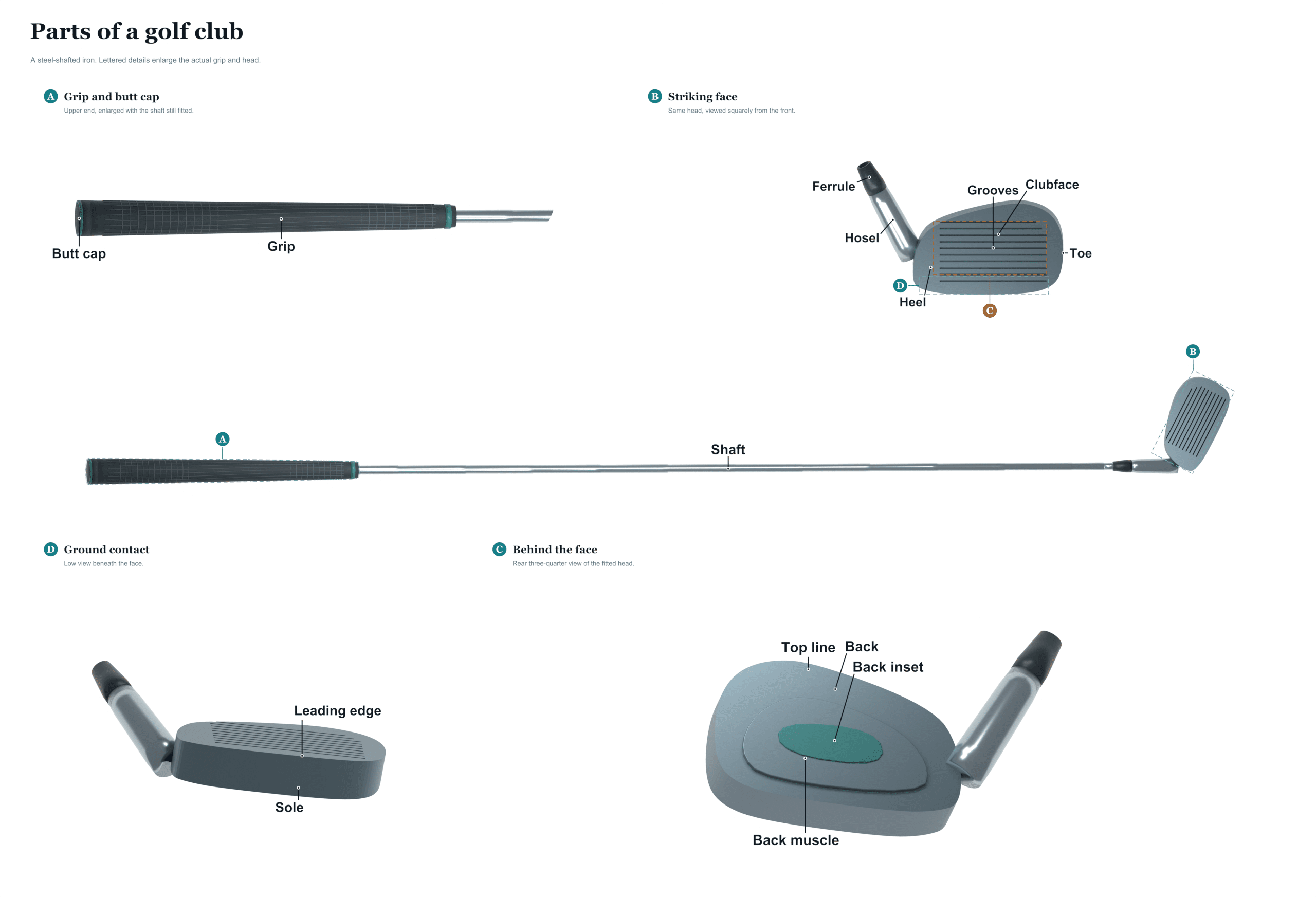
Golf Clubs are precision instruments. They give maximum control and efficiency from your swing into the ball. A golf club may appear to be just another stick with a weight at one end but in reality it’s a complex collection of unique components. All of which have a specific ergonomic or mechanical function. Knowing them allows for greater care of your equipment. Additionally, it enables you to speak with golf professionals about fitting or repairing clubs in ways they will understand.
Above is a diagram identifying the key components of a standard iron clubhead and how it attaches to the handle. As you continue reading the descriptions, match them up with the image so as to see precisely where each component is located in relation to the other.
The Parts of a Golf Club
Butt End
At the opposite end of the head, we have the very top of the club. That’s the butt end. Typically there’s a little cap or plug that seals this part of the club. The purpose of the plug is to protect the interior structure of the shaft from dust and moisture. It’ll also be the first end you come to if you should of choose to remove your grip for replacement.
Grip
The grip is the rough spot on the handle where you place your hands as you swing through. Most importantly, its job is to create traction and prevent your hands from slipping; even if they are sweaty. Because a slick or worn-down grip causes uncontrollable shots, keeping it in good shape is essential to consistency. If it gets smooth or sticky, just change it yourself.
Shaft
Between you and the clubhead is the shaft. That’s the flexible but strong column that connects them together. It also takes the shock of contact and stores some of it on the downswing. The weight and stiffness of a shaft can have a major impact on both the feel of the club in your hands and on the flight of the ball. It transmits the kinetic energy created through your swing directly into the head of the club.
Ferrule
A ferrule is the small decorative cap on the end of the clubhead where it connects with the grip. Usually, it’s either plastic or metal. Although historically, this was used as a way to conceal the join between the head and shaft, nowadays it’s primarily for looks. It adds a finished, professional look to the club and also prevents any wear on the material underneath.
Clubhead
This is the portion of the clubhead where the shaft gets inserted and fastened. It’s also known as the hosel. It’s a structural socket on the head that joins the rigid clubhead with the flexible shaft. By definition, this means the angle of the hosel will dictate the lie angle of the club, which determines how far left or right the ball lands in relation to your target. This area experiences a lot of stress at impact.
Neck
Just below the hosel is the neck; this is the top portion of the clubhead. The neck will narrow a bit then flare out into the rest of the head. But why is that important? Well, this part of the club plays an important role in how flexible and well-balanced your entire club feels. Some clubs has adjustable options in this area where you can change either the lie or the loft on your clubs.
This is what hits the ball. It’s the big end of the club, which contains a large amount of weight. Today’s clubheads are designed to fix mishits and send the ball on its way in the best direction possible. Head shape contributes to this. Weight placement inside the head also helps determine the stability and resistance to rotation (MOI) of the club.
Toe
On an open face, the toe is the outer portion of the clubhead. It is as close to the hosel as possible. When you tend to strike the ball on the toe, you’ll probably notice loss in distance and possibly a tendency for the ball to curve to the right. For a lot of people, this is where the leading edge wears down first.
Topline
The topline refers to the very top edge of the clubhead. It’s your primary point of visual reference on aligning yourself at address. A thicker topline can give the club a more stable feel while a thinner topline might assist in judging distance. Before you begin your swing, you look down this line and want to assure the face is square to your target.
Face
The face of the clubhead. The vertical surface of a clubhead that comes in direct contact with the ball is called the face. On the clubface it is positioned back slightly and is called loft, which assists in lifting the ball into the air. Dirt, debris etc on the face can change direction and spin of the ball. It is the most critical surface for trajectory control.
Grooves
The fine parallel lines that are cut into the club’s face are called grooves. The groove’s job is to divert water, debris and grass from the point of contact. When you have an imperfect lie, that action will help you control the ball and its spin. The grooves tend to be worn smooth over time, making them less effective.
Sweet Spot
This is the sweet spot. It is the place where you’ll get the best feel, accuracy and distance when you make solid contact with the ball. It is typically located slightly below the center of the face. That’s what we’re trying to find repeatedly in our practice rounds. This is the spot where we expect the most energy transfer during impact.
The bottom front edge of the clubhead which comes into contact with the earth is known as the leading edge. It’s the first point of contact in your swing and it needs to be tough enough to hold up to repeated impacts while at the same time being sharp enough to cut through the grass. Wearing away at the leading edge will alter the club’s interaction with the ground.
Trailing Edge
Opposite the leading edge is the back part of the clubhead called the trailing edge. This assists in shaping out the bottom (sole) of the club. How that edge is designed affects the club’s ability to glide across the turf. A good trailing edge will not dig down into the grass as much as you swing.
Hosel
The grip and shaft provide control over the motion of the club. The hosel and neck translate that motion to head movement. The face, grooves, and edges interact with the ball and turf to create the desired shot. Regularly maintain these areas on the specific components of your equipment to keep them performing their best. And if your shots are feeling inconsistent, check your grip for wear and make sure that the face is clean.