A double reed woodwind instrument is the bassoon. Its physical make-up is unique, as is its warm tone. The bassoon are important in an orchestra. Equally adept at playing melodic passages and bass lines, the bassoon has many distinct section that make up the instrument.
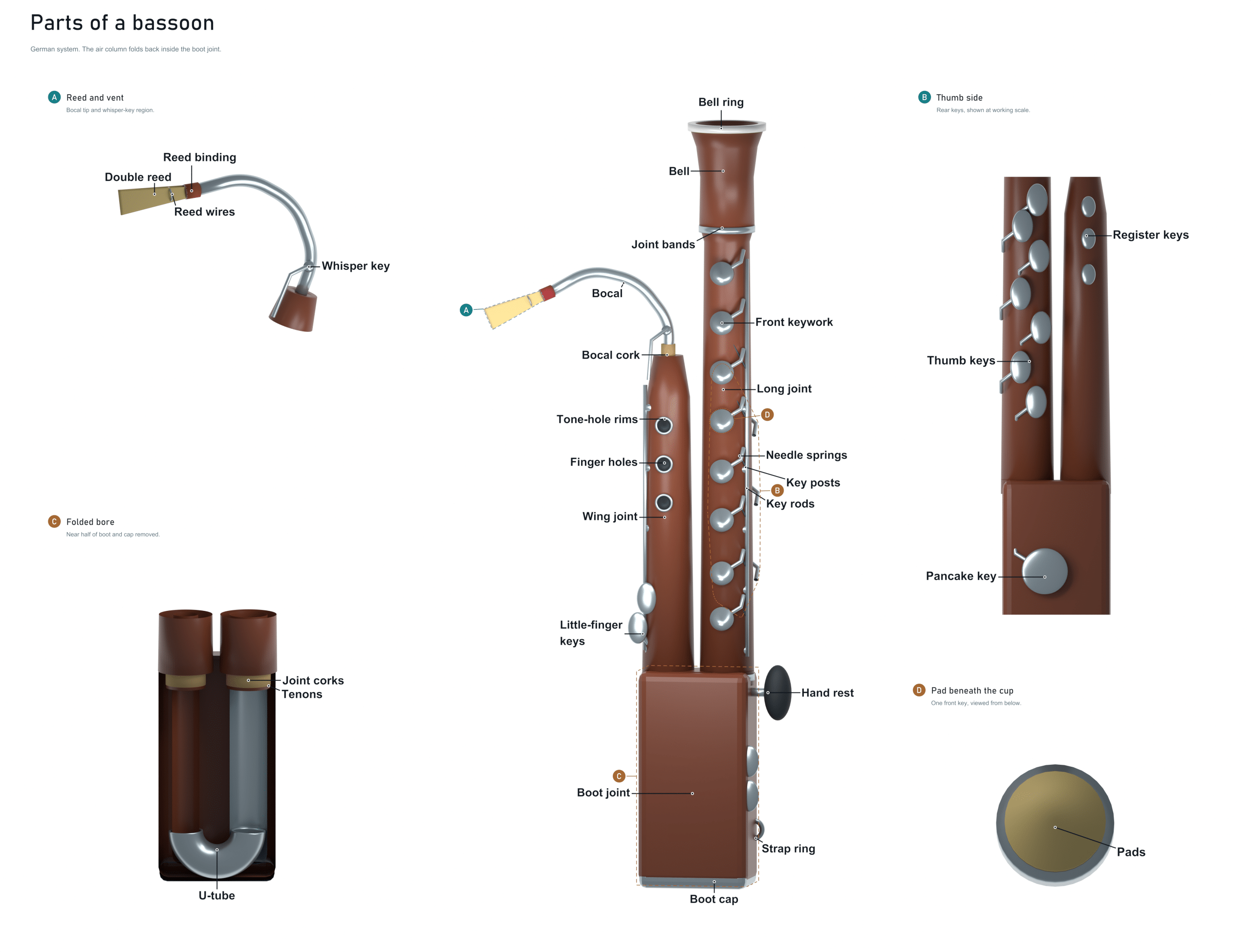
To play this instrument effectivey you need to be familiar with the anatomy of the bassoon. This is clearly illustrated in the diagram. The labels indicate how each section contribute not only to the structure but the sound too.
Parts of the Bassoon
Reed
His name is Reed. This sits at the top of the instrument. This produce the sound. To produce the sound you place the wire and cane between your lips, which causes the reed to vibrate. Tone and pitch is affected by the quality of the reed. Every player require their own reed.
Bocal
The reed attaches to the bocal. A curved piece of metal called the Bocal connect the reed to the main body of the instrument. The curve allows you to hold the instrument comfortabley. Through the Bocal, air flow into the bore of the instrument. Intonation is affected by the Bocal. Adjusting its depth of insertion change the pitch fractionally. This is something players often tweak prior to performing.
Keys
Below the Bocal is the Boot joint, which is shaped like a shoe. Below that are the lowest keys. Here you would played the deepest notes. Connecting the Bell joint and the Long joint, this section carry a significant amount of weight. Its keys need maintaining so that the lower notes functions well.
Long joint
This is the longest section, called the Long joint. It has lots of finger keys on it. Here you place your hands to alter the pitch. It connects the Wing joint to the Boot joint. This is the central piece of the instrument. If this is aligned well then the air flow will be smooth.
Wing joint
At the top, the reed joins the bocal. You rest your hands on the Wing joint. The Wing section is difficult to play as the keys is complex. They stick out like wings. They have holes for your fingers to play high notes. You need a good fit so it can be played quickly.
Near the bottom, close to the mouthpiece. It is shorter than other joints. It attaches the Boot joint to the Bell. It makes a pathway for sound waves. It has fewer keys than others. It still has mechanisms for trills and low notes. It stops air from leaking with a tight seal here.
Flared end of the instrument. Projects the sound. Amplifies the vibrations caused by the reed. Sends the sound out to the audience. Helps to balance the weight of the instrument. Can alter the tone depending on its shape.
Finger holes
They are rods and levers. They open and close finger holes. They can alters the pitch when pressed. Fingers don’t go on top of the holes. Keys should slide easy. Return quickly so that timing is accurate. They should of been kept clean. This ensures that the rods and pads works well.
Holes in the wood are called finger holes. These decide the pitch. Some are under keys, some are available straight away. They are carefully placed based off frequency. Knowing how they relate to the keys helps with tuning issues.
Hand rest
Padded Hand Rest The hand rest is a padded support attached to the side of the Wing joint. Here you place your left-hand to rest it, taking strain off your arms. The Bassoon is a large instrument that require support. The rest can be adjusted for comfort.
Bell
At the end of the Bell is a metal loop called the Seat strap ring. From this ring hangs the support strap which holds the instrument in place on your lap. The bassoon is heavy. Through the ring, you can adjust how tight or loose the strap is and have a secure hold on the instrument.
These all are working together. They produce the sound of the bassoon. If the instrument does not seem to be responsive, check the joints. Examine the condition of the reed. Proper assembly allow air to flow smoothly so the music sounds clear.