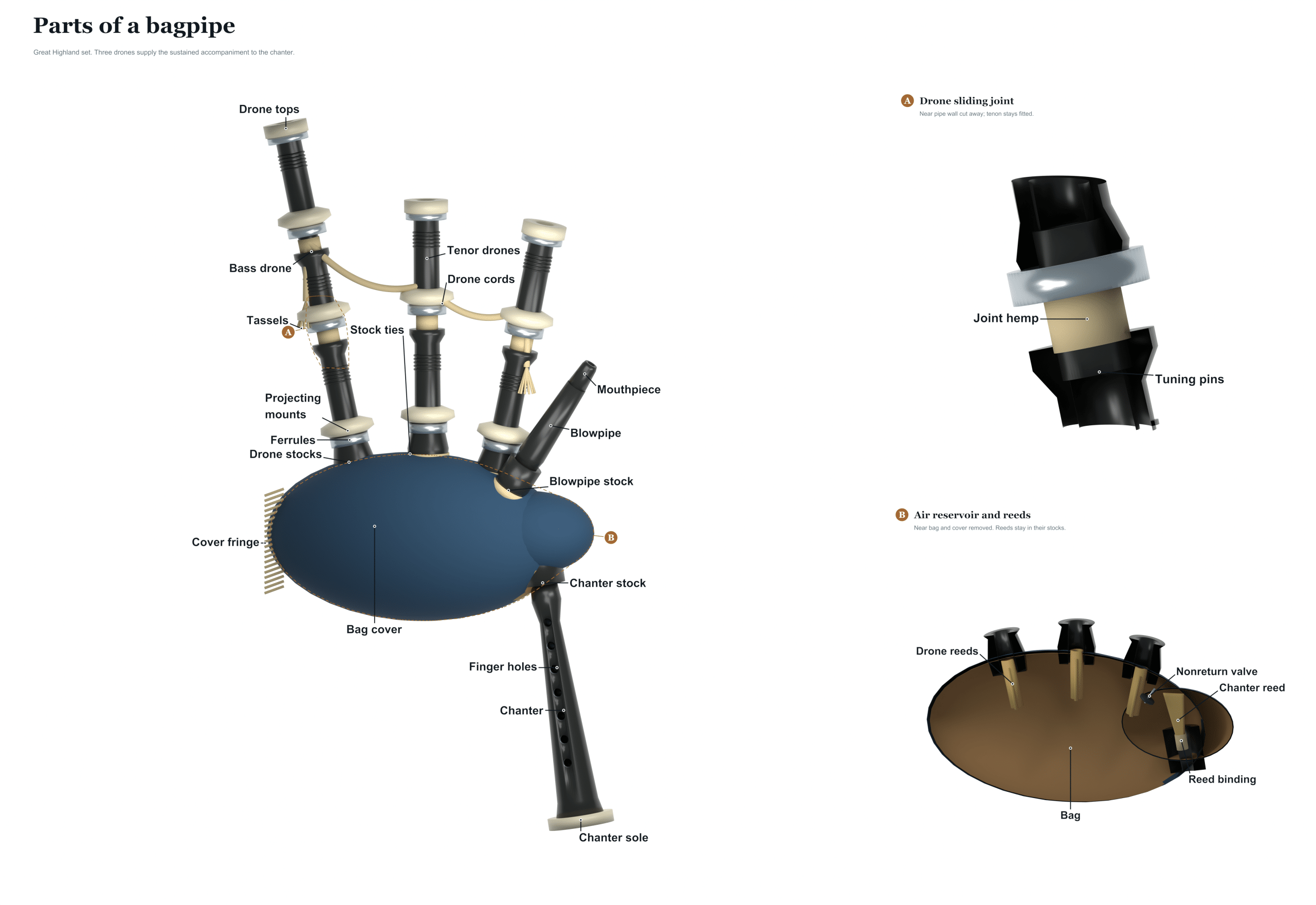
As a wind instrument, the bagpipe is quite an intricate instrument that depends upon a steady supply of air to create its characteristic, resonating tone. It has no valves or keys like so many other instruments which alter the note produced. Instead, the bagpiper must rely on their breath control and finger positioning.
If you are considering learning to play the instrument or want to know more about maintaining one, then knowing the structure of the pipe is essential. Above is a helpful diagram that clearly outlines the key parts of the instrument. From here you can name each element and understand how they work with the rest of the instrument. Following the air as it travels from your mouth into the reeds that make the sound allows you to understand more fully the engineering behind this age-old instrument.
The Parts of a Bagpipe
Blowpipe
The Air Tube, also known as the Blowpipe, provides the channel of air that supplies the instrument. It attaches straight to your mouth, where the constant stream of air enters to keep the bag inflated. The majority of blowpipes include a one-way valve that stops any air exiting towards your lips. This means you can change notes or take a break without deflating the bag.
As with all elements of the instrument it’s good practice to keep the blowpipe clean so accumulated moisture from your breath doesn’t build up over time inside the tube.
Mouthpiece
The mouthpiece. This is the piece that fits in your mouth. At the end of the blowpipe it’s there to give you an airtight and comfortable fit. The idea is that when you blow, it seals so no air leaks out but instead goes into the bag. Sometimes these can be made from rubber or even wood. Other times they might be a more durable plastic.
Check this section of the instrument for signs of wear and tear, especially for cracks. If the seal isn’t good then you’ll find it very hard work and tiring to play.
Chanter
The chanter is the main melody pipe where you place your fingers on the tone holes to play notes. It has a reed that vibrates to create the piping sound. Proper alignment of the chanter joint is important for a clear tone and to prevent leaks.
Tenor drones
Bagpipes has several main components, including the blowpipe, chanter, tenor drones, and bass drone. They are:
The chanter is the bagpiper’s main melody pipe. You put your fingers on this part of the instrument to open and close the tone holes. As you do so, the musical notes is produced. The difference between the chanter and the drones is that the chanter can play melodies and tunes while the drones creates a continuous drone note.
A reed is fitted into the chanter that is made to vibrate as air passes through it. This produces the distinctive piping sound. To get a good clear tone, the chanter must be aligned correctly in the chanter joint. Otherwise, there will be air leakage and poor sound quality.
The tenor drones. The tenor drones are the two shorter drone pipes that sit on your shoulder along with the chanter. It sounds a sustained harmonic note which underpins the melody being played by the chanter. The tenor drones are commonly pitched at the same note as the lowest note in the chanter’s range. Tuning slides allow each tenor drone to be finely tuned if necessary, perhaps when humidity or temperature affects the pitch.
Bass drone
The bass drone is the longest pipe in the assembly and produces a note an octave lower than the tenor drones, providing a deep foundation for the overall sound.
The bass drone is the lowest of the pipes in the set. Depending on the type it either sits on your shoulder or hangs across your back. It sounds an octave below the tenor drones. It gives a solid base to the entire sound. It adds resonance and weight to the piece. The bass drone fills out the harmonic structure too.
In much the same way as the tenors, the bass drone has a mechanism for fine-tuning its pitch. This enables you to tune it with the other instruments.
Drone cords
Bag cover
The bag cover is basically what covers the main air reservoir. The straps hold the drones on your body as you play. The idea is that they keep the bass and tenor drones in place relative to your back and shoulder. Without the straps, the drones will move around, making it impossible to keep a steady posture or produce a consistent sound. These straps come with some adjustment to accommodate your size comfortabley. It also helps spread the instrument’s weight across your body. This lessens fatigue when practicing for extended periods.
Bag
This is the bag cover, which surrounds the primary air reservoir. Common materials are leather, wool, or synthetic fabric. Its purpose is to insulate the bag. Maintaining a steady temperature in the bag is essential to keeping your pitch constant. If the bag gets cold, then the reeds will flatten out. The bag cover also protects the bag material from wear and tear.
Make sure to check that your bag cover fits snugly. It should not be too loose where it comes off, but not so tight that it prevents the bag from expanding when you blow air into it.
It is a bag. This is where all of the air for your instrument comes from. When you blow into the blowpipe, the air passes into the bag. The bag acts as a reservoir, storing the air until the instrument needs it. From here, the air travels at pressure to the drones and chanter. Here it maintains a constant flow so that you don’t have to stop playing to take a breath.
Traditionally, bags were crafted from sheepskin. Nowadays, they often come in synthetic materials too.
Watch the air level closely. If the bag has insufficient air you won’t hear any sound coming out. On the other hand, if it’s overblown, it can damage the reeds or force an unpleasent distortion on the tone.
Drone reed
This is a drone reed. Each drone contains a small reed that vibrates to produce the sound. This reed is known as the drone reed and it’s a delicate piece of either synthetic or cane material. This sits in the drone socket. Its job is to produce the drone note with the right tonal quality and stability.
If your drone won’t begin playing at all or sounds scratchy then perhaps the reed has become stuck. It could be incorrectly seated or even damaged. As time passes these reeds will wear out. Often they should of been replaced to make sure of a pure and clear tone.
Drone stock
The drone stock is the small piece of wood (or some other type of plastic) that joins the drones to the bag. It keeps the drone reed firmly in position. It also provides an airtight fit between the drone and the bag.
If you find there is a leak of air at any of the joining points then it might well be because the drone stock has come loose. Alternatively, it may have become damaged. As these fittings recieve quite heavy use as you change reeds and adjust the pitch of your instrument, they need periodic checks for any form of bending or wear.
These elements combine into a coordinated mechanism when playing the bagpipe. Air enters the bag via your breath, which then supplies air to both drones and the chanter at the same time. If the sound is not consistent or stable, start by checking the seals on the drone stocks, chanter, and blowpipe. Are the reeds operating as they should? Is the bag warm? With a well-tuned instrument and well-fitted components, it will respond smoothly to your fingers and breath control.