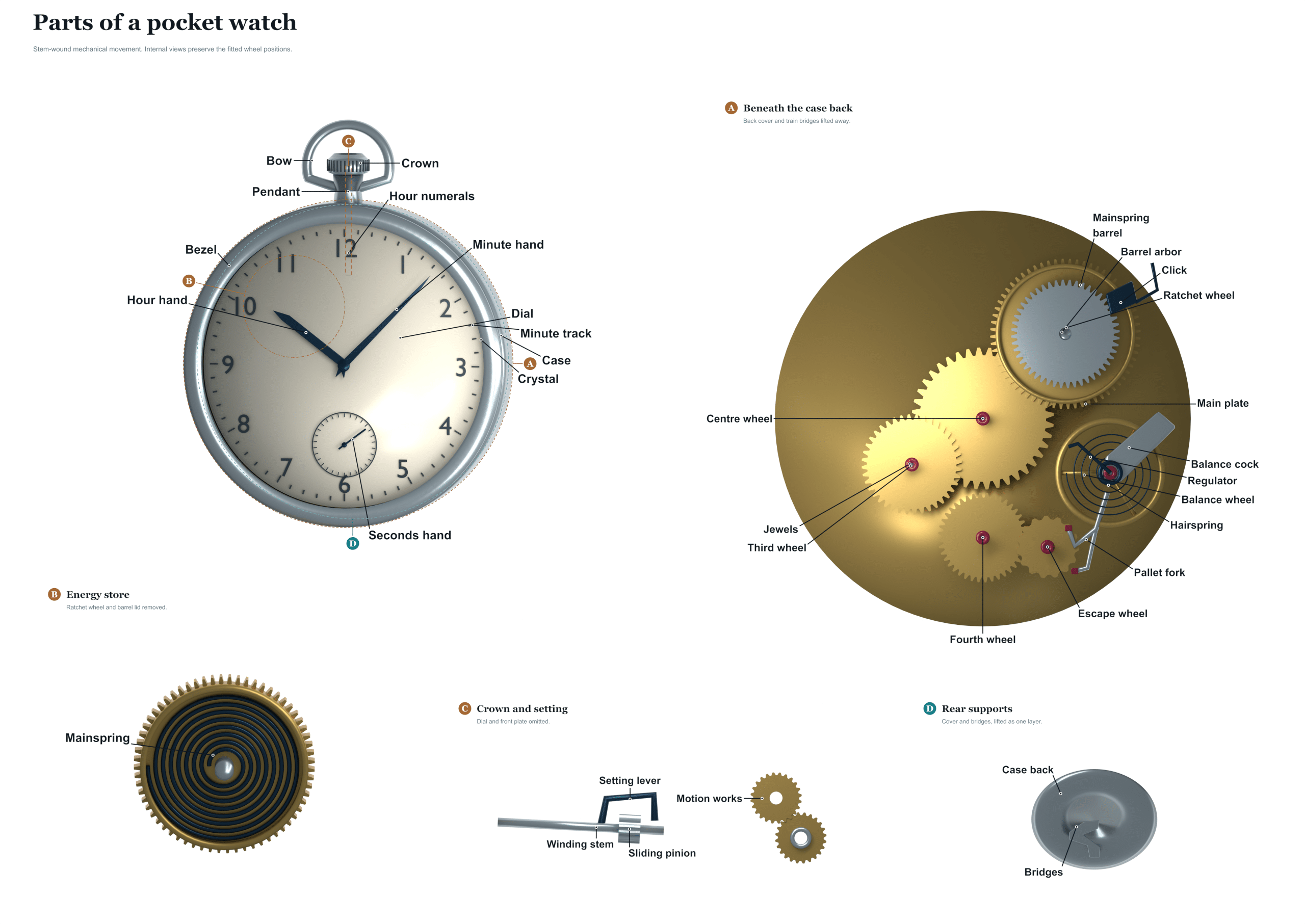
This is a pocket watch.
The Pocket Watch is a mini marvel of engineering that can hangs from a chain or sit in your pocket and keep accurate time. Since it is not worn on the wrist like a wristwatch but is checked from time to time the way the parts are shaped and arranged reflects this use. It use mechanical parts to accurately show the time, store energy and control its release.
Parts of a Pocket Watch
Looking through the diagram, you’ll notice how the pieces align to make up a working timepiece. Knowing what each part does allows you to fully appreciate the craftsmanship. It also provides you with a common language when describing repair and/or maintenance.
Begin with part of the watch that you interact with most often (top) and move downward toward the mechanism. The curved metal loop at the very top of the watch case is called the bow. That’s where a lanyard or chain would attach to keep the watch hanging safely on your belt loop or inside your vest pocket. Often marked with the manufacturer’s name, the Bow must also be strong enough to hold up the weight of the whole watch but not bend out of shape.
Pendant
Below the bow is the Pendant, a stem-like structure that extend outward from the case. When pulled or turned, the pendant engages with the internal movement. Decorative patterns is often matched to those on the case, and the pendant itself is typically formed to make it easy to handle.
Crown
The pendant has a crown at the bottom end, which is the knob that allows you to pull to set the watch and wind its mainspring. It’s a tiny little piece but crucial to day-to-day use as it will connect directly with your fingers to convert energy into the system. A properly functioning crown will have a nice snap as it returns to position after being turned and will also rotate smoothy.
Bezel
The Bezel, Rim around the outside of the watch that surrounds the front face of the watch and holds the crystal in place while protecting the edges of the dial. Depending on the design, the bezel may be hinged or fixed and frequently adds another element to the overall look of the exterior.
Crystal
The crystal is the clear window over the hands and dial that protects them inside. Vintage watches are typically covered by acrylic or mineral glass and should of been inspected periodically for any signs of fogging or cracking which would suggest a failed seal.
Dial
The dial is what you see when you look at your watch. It’s the crystal-covered face of the watch, displaying the minutes and hours. Depending on the watch, it can have a printed numeral dial, an applied marker dial, or even subdials for other functions such as seconds. Since the hands move over the stationary dial, the dial’s clarity and condition are important for reading the time accurately.
Second hand
The hands are the second, minute, and hour hands that all sweep across the dial. The second hand is usually the longest and thinnest; it ticks or sweeps around the dial marking off each second. The minute hand is longer than the hour hand but shorter then the second hand. It goes all the way around the dial in one hour. And finally, the hour hand is the slowest-moving of the three and completes a full circle every 12 hours. All of these hands need to be properly aligned and move freely without coming into contact with one another or the crystal.
Case
The case is the outer shell that surrounds and protects the inner workings. It protects delicate gears from moisture, dust, and physical shock. Typically made of metal (steel, silver, brass, etc.), the case also contains what is called the hinge.
Hinge
The hinge is a small, yet important mechanical joint on the side of the case. It enables the back cover to swing open for servicing or inspection of the movement within the case. If your hinge feels loose, the case back may fall off. A stiff hinge may be a sign of dirt build up.
Movement
The movement is the whole mechanical assembly that makes the watch tick. Within the case you’ll find hundreds of tiny jewels, springs, and gears all working in perfect harmony.
Mainspring
The Mainspring is a coiled spring that stores energy during winding. When released, its tension turns the gear train. To make sure the hands rotate evenly, the energy needs to be controlled. That’s where the Escapement comes in. It regulates the release of the energy in measured amounts.
Balance wheel
Working together with the Balance wheel, which rotates back and forth at a consistent pace, the escapement adjusts for fluctuations in speed due to gravity and winding tension. These parts work together to convert potential energy into predictable time.
Chain fob attachment point
Last but certainly not least, the Chain fob attachment point is the little ring or loop that attaches a decorative chain. This keeps the watch facing up in your pocket so the crown is accessible and the watch is not upside down.
The watch is an integrated system with every part contributing to the flow of energy and its control. The escapement/balance wheel is responsible if your watch is running fast or slow. A clogged gear could cause it to stop completely. A totally unwound mainspring would cause it to stop too.
Winding the crown gently is regular maintenance, and keeping water/moisture out by making sure the case is securely shut is important. Knowing what each labeled part does will help you take good care of this complex moddern mechanical device.