Sundials are ancient devices that tells time using the suns rays. As the sun travels through the sky, it cast a shadow. That shadow tells us what time it is. All we need is the sun. No electricity or batteries required. And it’s quiet.
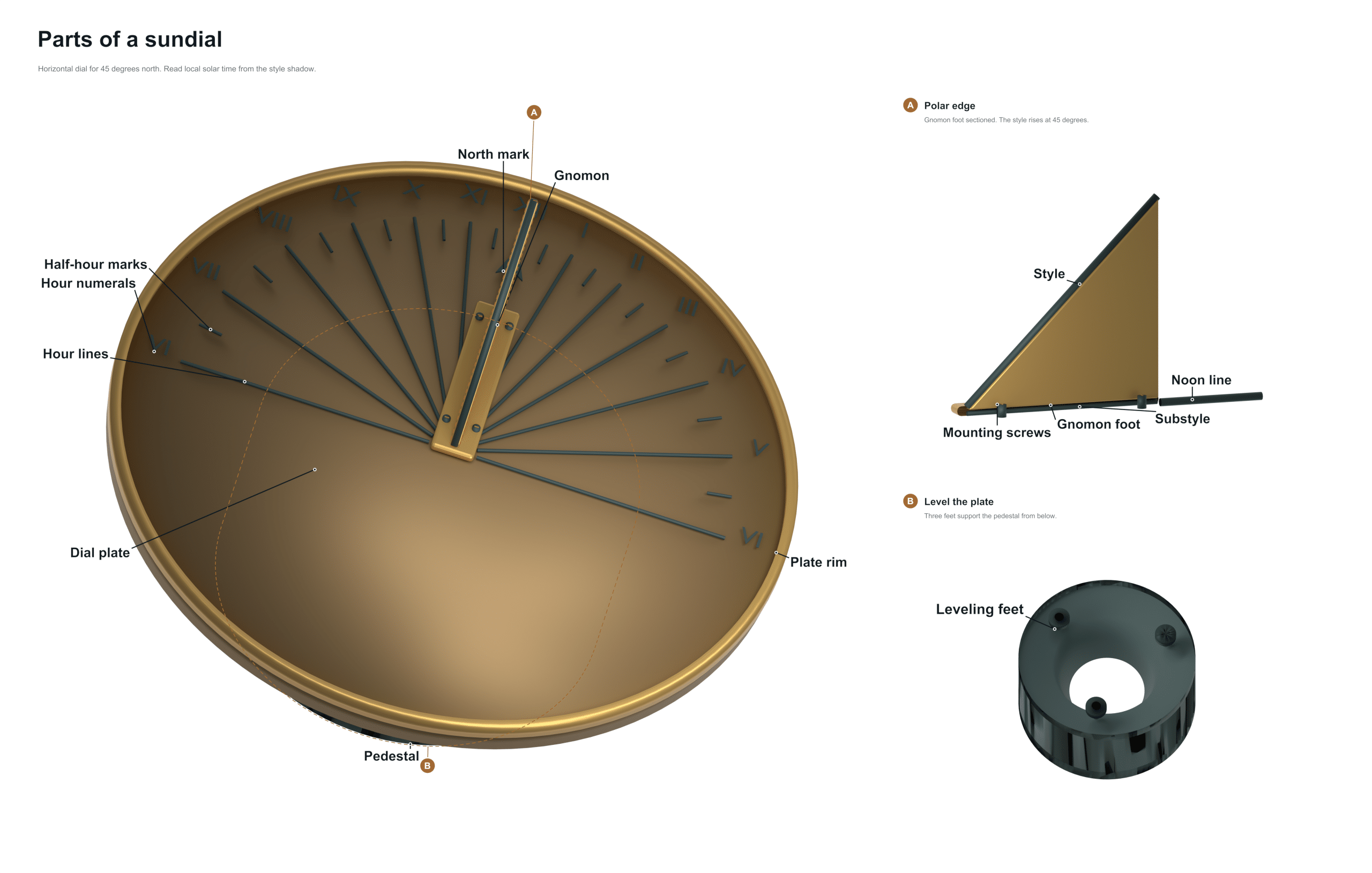
Before proceeding, take a look at this labeled diagram. This is a horizontal sundial. If you want to make or repair one yourself, knowing their names will help. Each piece serve a purpose. The design appears simple, yet there is more than you can see.
The Parts of a Sundial
Gnomon
What’s the Gnomon? That’s what sticks up out of the main surface. It is sometimes called the edge that create the shadow, and other times it mean the entire thing. Accuracy depends based off the angle of the gnomon. To point at the celestial pole (Polaris in the Northern Hemisphere), it needs to be parallel to the rotational axis of the Earth. Otherwise the shadow won’t fall onto the correct line. Typically you’ll see the gnomon, dial plate, or pedestal built of wood or metal. These are materials that stands up well outdoors.
Style
That’s the edge, and it’s what gives the shadow its style. That’s part of the gnomon structure. The style is the thin visual line indicating the time. To do this well, the style needs to be thin and create a sharp shadow. A thick shadow is difficult to read. The style could be a sharp metal edge or perhaps a wire. On a sunny day you can see if the shadow has a good quality by looking at the edge of the shadow. Is it fuzzy? Clean or repair the style. You’ll be able to read the shadow clearly and tell the correct time.
Dial plate
A dial plate is what you call the flat part with the time marks. Think of it as the “face” of the clock. They are typically made out of wood, metal, or stone. These items hold up well in the elements. The dial plate needs to be stable and level. If it’s not even, the shadow will be distorted. Sometimes there is text or other carvings on the dial plate. Keeping the dial plate clean allows the markings to remain legible. This ensures the instrument function correctly.
Hour lines
On the dial plate there are hour lines that correspond to specific times. The lines begin in the middle of the dial plate going out towards the outer rim. Unlike the number lines on a watch, they is not spaced evenly apart. Because the sun travels at a constant rate, its shadow does not travel at a constant rate when on a flat surface. Watching where the shadow lands lets you know what time it is. Make sure the lines are clear so you can see them. Over time the sun and rain will fade the lines. Touching them up or repainting them may be necessary later.
Noon line
When is the sun highest? That’s noon. The noon line is the key for setting up your sundial. In the Northern Hemisphere it needs to point toward true south. In the Southern Hemisphere it needs to point toward true north. You can use a compass or astronomical data to determine that line. All the other times are going to be off if this line is incorrect. Align with this line as a reference.
Pedestal
It is a sundial pedestal. The sundial rests on the pedestal. The pedestal lifts the dial plate high enough off the ground. And it anchors the sundial firmly against the wind. A good pedestal should of be solid and level. If the pedestal sags, the sundial will lean. This throws off the accuracy of the sundial’s time-keeping. You might construct your pedestal out of metal, concrete, or even stone. A solid pedestal maintains the proper angle of the dial plate so that accurate reading can happens.
Mounting plate
This is the pedestal, which holds the dial plate and gnomon on the mounting plate. The mounting plate is what connect the sundial to the pedestal. Before you lock it down, you can adjust the direction and level. You can use screws or slots to rotate or tilt the device. Adjustments like these will help you align the pole to the gnomon. If there are irregularities in the local topography or foundation, you can account for them here. Once it’s aligned, tighten the mounting plate into place. This will give you a secure fit that will keep your sundial working for a long time.
Together, they display the time. The style and gnomon cast a shadow. The shadow is read against the dial plate and its hour lines. The mounting plate and pedestal keep it all in place. If the sundial doesn’t tell the right time, check the level of the plate and the position of the noon line. Keep these parts in good repair and the sundial will be accurate. Knowing what the parts are will help you use this ancient technology well.