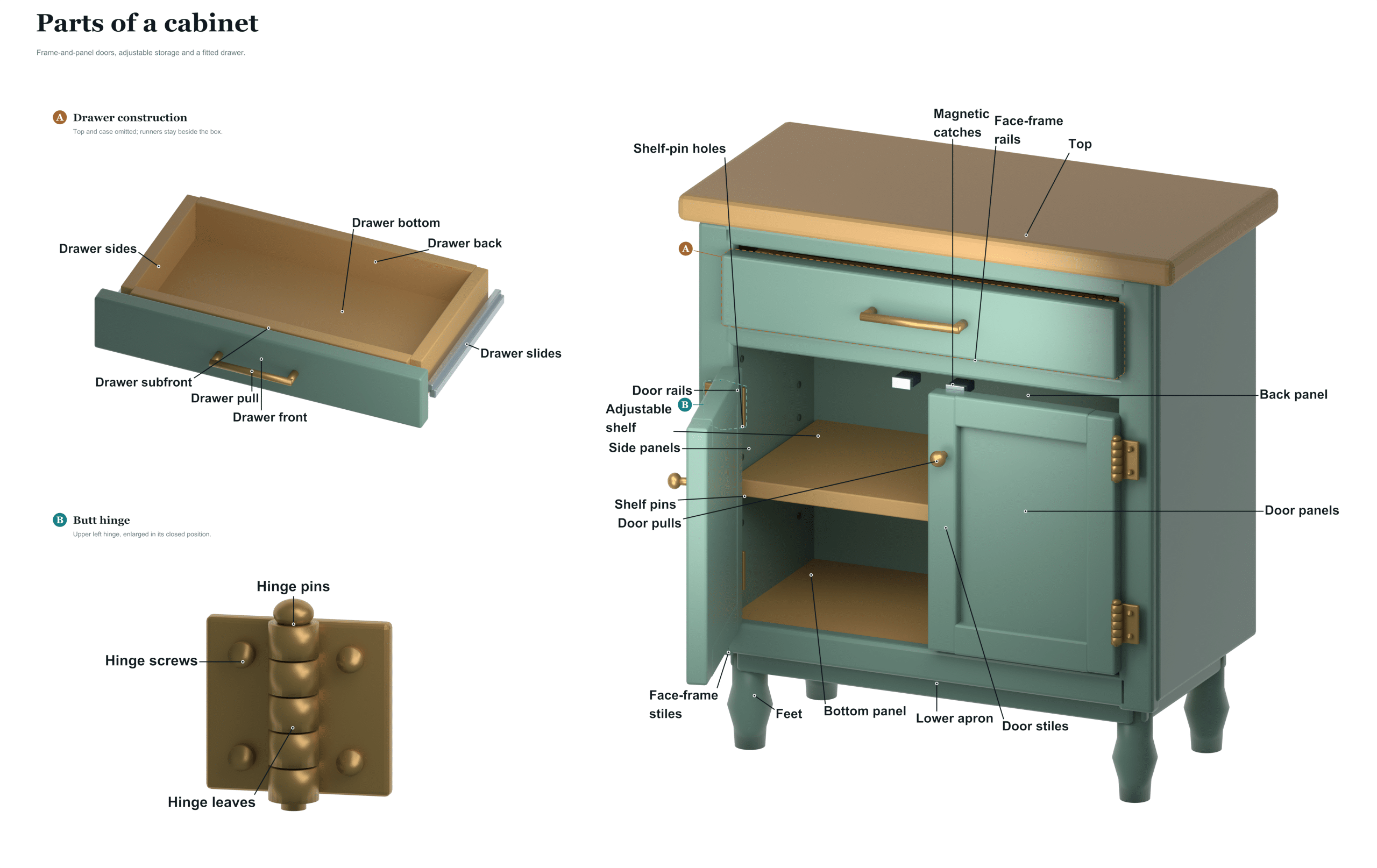
When building a cabinet, everything that goes into it serves a purpose and holds up the rest of the structure. You might be fixing an older cabinet, building a new one from scratch, or just wanting to learn more about your own furnitures. It is important to learn the names of the following pieces.
With that said, here’s a quick run-down on the anatomy of a typical cabinet (the diagram above) and what to look for when reading through the rest of the post. Knowing what all the different pieces do will not only simplify future repairs but also allow you to catch potential problems while they’re still small.
Parts of a Cabinet
Frame
First is the frame. The frame is what gives the whole thing rigidity and keeps everything else in place. If you don’t have a good frame, then the whole cabinet will fall apart and not be able to hold anything inside it. Usually this piece ties into the top panel, side panels, etc. This give the whole thing rigidity against twisting forces.
Top panel
The top panel completes the cabinet and supports any items placed on its surface. The top needs to be sturdy enough for heavy loads and not sag. The top panel also hides the tops of all the sides and back panels, giving the cabinet a finished look. When installing the top panel, make sure it’s level so the doors will match up with the frame correctly.
The Anatomy of a Cabinet These are the left and right sides of your cabinet. Usually, these are the highest panels in a cabinet and determine how wide that piece of storage is going to be. Often there are slots cut out of them or holes for attaching drawer slides and shelves. You’ll see that the side panels joins directly to both the top and bottom panels to form the basic enclosure.
Bottom panel
This is the bottom panel that rests on the toe kick area, or on the floor. It holds the weight of whatever you store inside it, and gives the cabinet rigidity from underneath. Without this panel, the sides will eventually bow outwards. Keeping the area under the bottom panel dry and clean is important so as not to damage or warp the panel.
Toe kick
Do you notice that little recessed area at the very base of the cabinet? That’s called the toe kick. The purpose of this is to provide space for your feet when standing next to the cabinet without hitting your toes. It also provides a cleaner look to the cabinet and conceals the bottom panel. During your cleanings, be sure to check here as well since you may find some dust/debris.
Back panel
Back Panel Not only does it give us a place to attach the frame but it also connects the other sides (top, bottom & side) adding a lot of rigidity to the cabinet. The back panel also helps prevent pests from getting in. Back panels are often just a thin sheet that gets screwed into place or snapped into a groove.
Shelf
Inside, there is a shelf that offers more horizontal storage space. Depending on your cabinet, this shelf may be adjustable, so that you can move it up or down into different sets of holes in the side panels. That way, you can fit the interior to suit whatever size objects you plan to store. Make sure that the shelf sit solidly on its supports when you put something heavy on it.
Drawer
Pull-out storage box: The drawer is what holds your items. It has the handle and glides in and out on the drawer slides. It needs to align correctly so that it doesn’t bind against the frame. Usually this means adjusting where the drawer front sits, which you can do by just loosening the screws on the drawer slides a bit.
A drawer is the box that contains what you put in it. It slides back and forth on the drawer slides and is behind the drawer front. It should be strong enough to support whatever you place inside without breaking or bending. Make sure your drawer has a solid bottom so things don’t fall through.
Drawer slide
Drawer slide Drawer slide refers to the hardware used for a drawer to move back and forth. It is either made of metal or plastic and is attached to the side of the drawer and the side panel. When you open and close the drawer many times, these drawer slides takes all the friction. Keeping them free from dirt and grime will make your drawers work smoothly and last longer.
Door
This is what connects the door to the cabinet body. The door has hinges that hang from this piece, allowing for the door to swing open. To make this look nice in the finished cabinet you want this piece to fit tightly inside of the opening. You may have to play with where this sits so that your door will close tight against all other doors and side panels.
Handle
A handle is what you grab when opening a drawer or door. It is screwed onto the door/drawer front. Because this piece receives a lot of physical wear, it needs to be well attached. If your handles is loose, they will eventually break or cause damage to your furnitures. Check them occasionally and tighten as necessary.
Hinge
A door hinge joins the door to the cabinet body. It enables the door to be swung open and shut again and again. Most hinges today are adjustable in three directions so that you can adjust your door’s position. Screwing up the hinges usually fixes a problem of rubbing or sagging of the door.
Stile
What about the rest? A stile is that piece on the side of your drawer fronts or doors. It’s what keeps the rails in place and is the vertical portion of the frame. Structurally it supports the face of the door. The stiles is where the handles and hinges are usually mounted.
Rail
The rail is the horizontal part of the frame around the door or drawer front. It runs between the stiles to hold up the middle panel. Without the rail, your door will warp and lose its shape. Together with the stiles, the rail forms a sturdy frame that keeps the delicate door panel safe from harm.