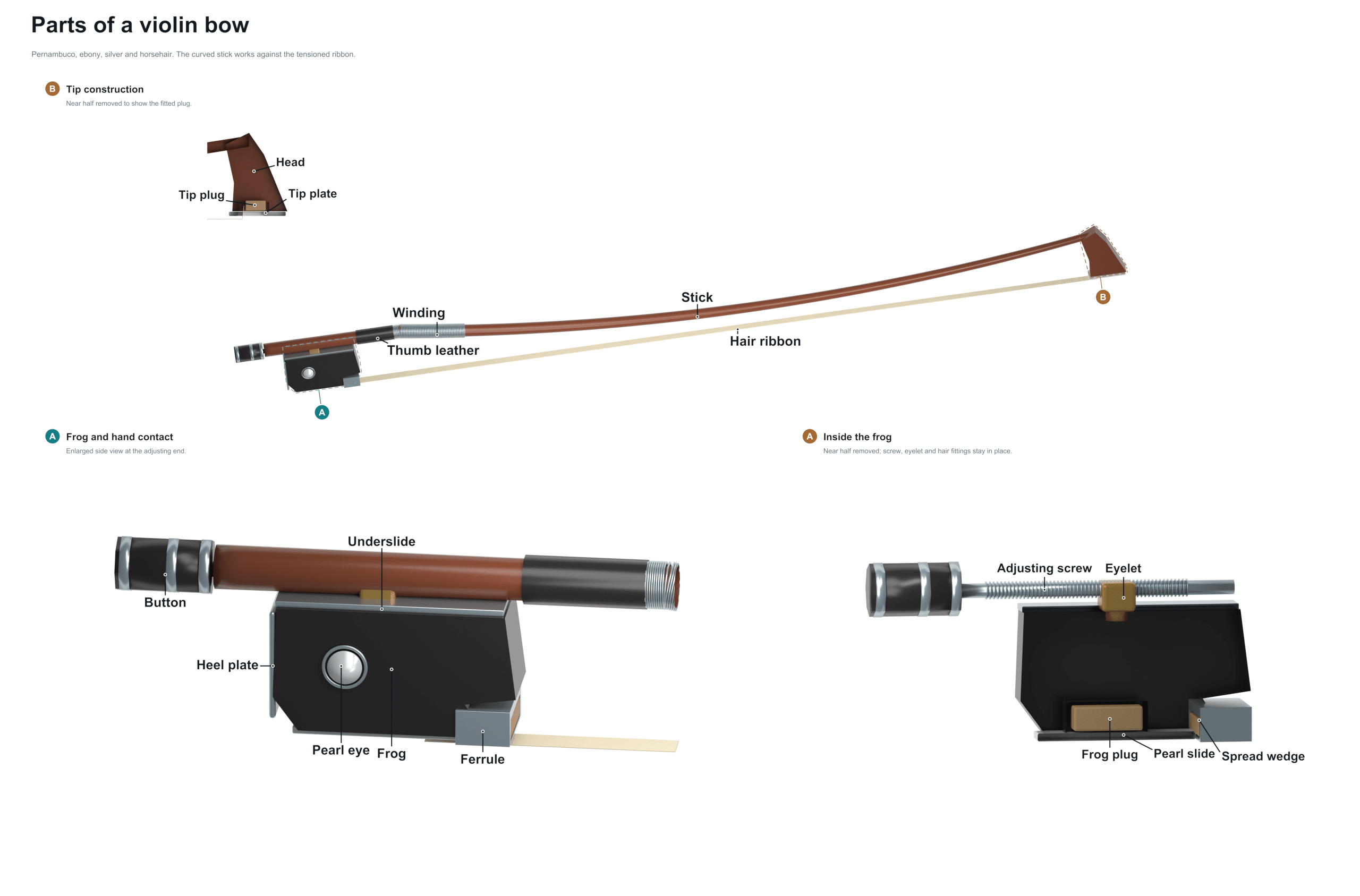
As a violinist, you know that the bow is a complex piece of machinery. It transforms your hand movement into carefully controlled vibration. This allows you to create a clear and ringing sound from the instrument.
Understanding the anatomy of the bow will assist you in caring for it. If the sound is not even, you may be able to fix it. If something breaks or gets lost, you will have an idea of what was missing. The drawing above shows all the components of the violin bow labeled. It serves as a guide to get to know them. This knowledge enables you to admire the craftsmanship and know how to care for this extension of your musical voice.
Parts of a Violin Bow
Tip
The tapering part called the tip is the end of the bow furthest from your hand. This is the point at which the stick joins the hair. Often this area will be reinforced by a piece of ivory or a small piece of wood. It’s essential that you have good control over this section as it is the outermost end of the bow from the pivot of your wrist. From here, you want to create a clean sound. Any looseness in the tip will impact the tone produced. The wood may even split and make the instrument unsafe too.
Head
At the end is the cap-like structure called the head. Its function is to protect the tip assembly. Frequently decorated, it can be fancy. The head secures the tip wedge. This is what keeps the end of the stick together. It’s made to cushion and protect the delicate joinery from bumps when being transported or played. When it fits well, the head provides consistent tension. Even on the extreme end of the stroke.
Stick
The long, slender shaft is the stick. It is the backbone of the bow. The stick is usually either a material called fiberglass or pernambuco wood. It needs to be both resilient and straight. That is, it needs to store and release energy effectively. The curve on the stick is known as the camber. This curve presses the hair onto the string. The camber allows the hair to press against the string with the correct amount of pressure. A crack or warp will compromise this structure. It will change the feel in your hand.
Hair
Hundreds of fine strands make up the hair. It is from the tails of Siberian horses. The horsehair is laid flat on the stick. The hair creates friction between itself and the strings. The horsehair has microscopic scales. These give the horsehair good string-gripping properties. This is lacking in synthetic fibers. Regularly rosin the hair to ensure a good grip. Replace when the hair gets brittle. When the strands get sparse, you know it’s time to go again.
Winding
The winding is a thin metal wire that winds round the bottom section of the stick. It is there for functionality as well as decoration. Without it, the tension on the hair can cause the wood to split. It also gives a textural feel to the stick which aids stability when you are playing. It is usually silver or gold. Rosin dust should be kept off the winding to maintain its look.
Leather Grip
The leather grip is a piece of leather. It is glued to the wood. It is at the bottom. It goes over the bare wood. To give you something that won’t slip. And it doesn’t. It’s what your fingers rest on. It is made of absorbent material. It absorbs sweat. It reduces any skin-on-bow friction. This enables easy changes of hand placement. Eventually, however, the leather wears down. It tears away from the wood. It causes discomfort. It can even cause a loss of control. When it does, out with old and in with new.
Thumb Grip
The thumb grip is a padded pad positioned on the side of the frog. Underneath, it’s right where you rest your thumb. It is made of either synthetic material or leather. The purpose of it is simply to give you some cush when you’re practicing and practicing and practicing. That way your thumb has the natural ability to bend as needed. Various bowing techniques require it. If your thumb grip is worn out you will start getting tense. When your thumb grip is hard it makes it harder to produce an even sound.
Frog
A small metal ring called the ferrule separates the frog from the stick. It separates the stick from the frog. Spacers make sure things is smooth and allow the frog to move freely without pinching the wood. It also allows the tension to be spread out evenly. It spreads the tension evenly across the width of the stick. Sometimes the ferrule is one piece with the frog, other times not. If it’s a separate part you can change it out.
It is a heavy block of material. It is near the bottom of the bow. They are made of wood, mother-of-pearl, or composite material. It slides up and down on the stick You can change the tension of the hair. It anchors the hair at the bottom. It houses the mechanism to tighten it. Its weight affects the overall feel It helps you control fast passages. It also helps with heavy strokes.
Eyelet
The eyelet is actually a small metal loop attached to the front of the frog. The bow hair goes through one end of the eyelet and holds the hair on the moving frog. That is why it must be secure. It’s under constant tension. A loose eyelet will cause damage. It can also corrode, which causes it to fail too. You need to have it repaired immediately by a luthier.
That’s a threaded rod that is screwed into the frog. That screws into the tip plate. That’s how it operates and turns the frog. Tighten and loosen the hair. The screw on your cello adjusts the tension. Do this before you play. And it will operate smoothly if properly lubricated. It won’t seize up on you.
That’s a button, and it’s the cap on the screw end. It was made to be easily gripped with your index finger. You turn it with your index finger. It enables you to make quick adjustments to the tension. You do not need any tools. Some are dressed up with an inlay. The shape helps make turning the button comfortable. But if the button gets loose, it won’t adjust well either. And if the button strips out that’s another problem. Keep it checked periodically as they will ware.
All these components work in harmony. This turns movement into sound. The lever created by the stick. The hair has friction. You can control the tension precisely on the frog. If you feel that the sound isn’t quite right check the tension on the hair. Also, the rosin? Does it need more? Try and see? Check the bow if its balance feels wrong. Are there any warps on the stick? Is the frog moving freely? A well-kept bow is a good bow. It is responsive, and it stays this way with care.