The hinge is a tiny piece of mechanical hardware, but it’s what makes heavy doors swing open and closed easy. It supports all of the door’s weight, yet offers a smooth pivot point every time we use it. Carpenters and homeowners would do well to know the parts that make up a door hinge. Knowing which one is failing when one start to sag or squeak makes fixing it easier.
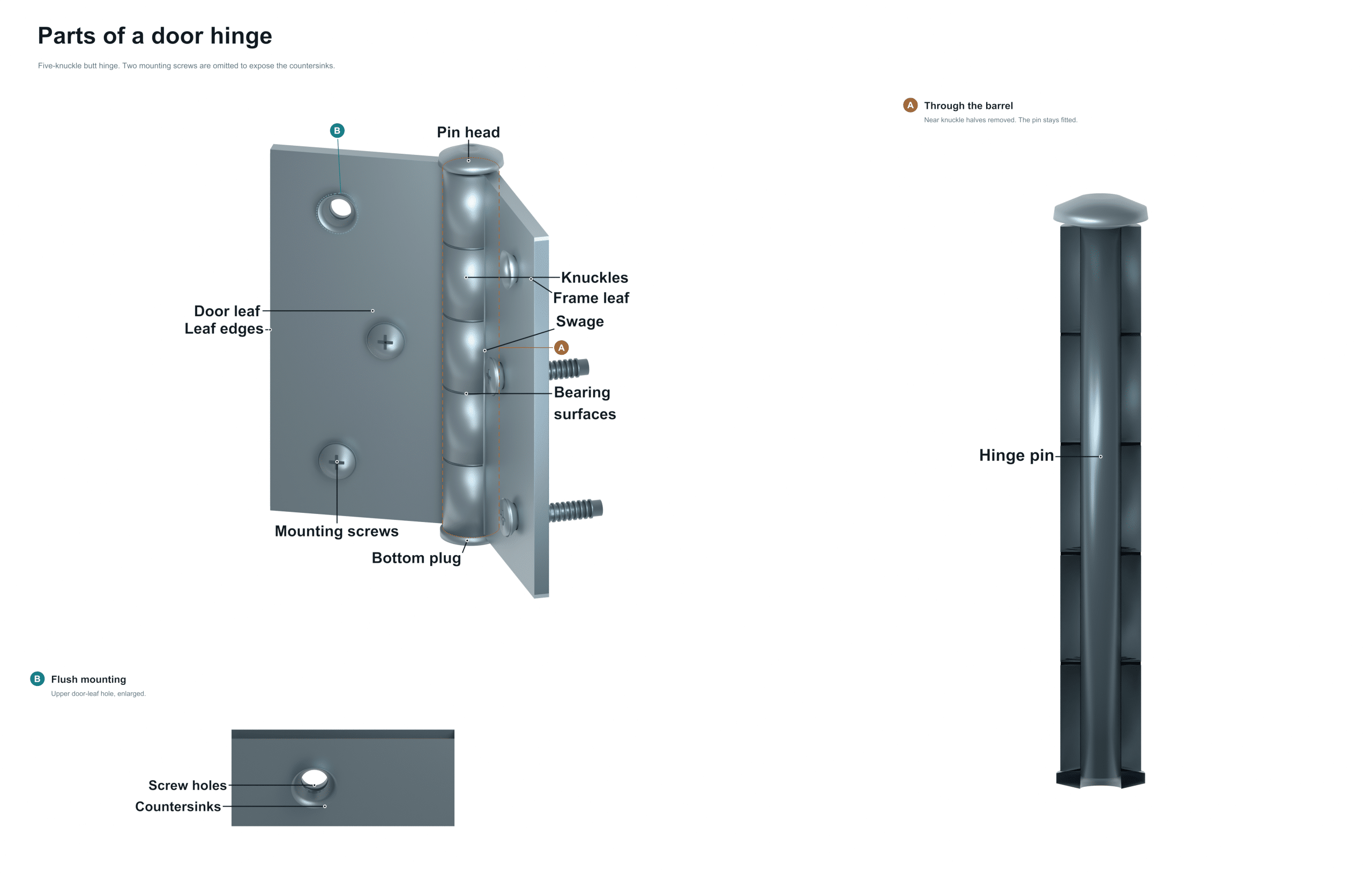
Above is a diagram that breaks down a hinge into the basic pieces. You’ll see a list of labels in the image. These are the names for the various hinge parts so you know what each part is and how it works within the mechanism. Follow along with me as I walk you through each piece and explain how they works together to hold the door in place.
Parts of a Door Hinge
Knuckle
The central part of the hinge is called the knuckle. Knuckles is the cylindrical portion that connects both flat pieces of the hinge. The knuckle acts as the main bearing surface for smooth rotation. In a typical hinge you will notice several knuckles stacked on each other. The purpose of this stacking is to add structural stability and strength. If the hinge appears loose or the door seem wobbly, the knuckles could be worn down, which compromises the whole assembly.
Pin
There are two metal plates called leaves. The pin is a solid vertical rod running through the middle of these two knuckles. They keeps the two parts of the hinge connected. And they also allow the door to swing back and forth on this pin, rather than having the metal plates grind against one another. On most hinges you can remove the pin by punching it out with a punch and hammer. That way you can remove the door from the frame to service it if needed. If your pin is broken or loose you will have to much play in the hinge. This results in an uneven door and a rattle when opening and closing.
Barrel
Each knuckle has an outer shell called the barrel. This barrel is typically constructed from hardened steel. Hardened steel helps prevent wear and deformation with repeated use. Inside this barrel is the pin. And inside the barrel is where the smooth operation occurs. When you look at a hinge closely, you’ll notice that the barrels on the top and bottom plates has a slight gap between them. That gap gives the hinge its required range of motion.
The knuckle is the part of the hinge where the two leaves meet. In other words, the part where the hinge bends. Leaves are the flat, rectangular plates that project outward from the knuckles. They’re the parts you screw into both the door and the door frame. How strong the leaf is will determine how heavy a load the hinge can bear. So a weak leaf might bend or tear out of the wood. Often, leaves are beveled (i.e., have an angled edge). That way, as long as the door is closed, the leaf sits flush with the door. A common failure point is a cracked or stripped leaf, especially one caused by using the wrong size screws during installation.
Leaf
In the leaf there is a pre drilled screw hole. The hole is for mounting screws. The location of these holes is key because they will line up with the hinge on the jamb and door. Typically each leaf has 2 or more screw holes. These holes distribute the load to prevent the hinge from pulling away. When the wood is stripped out around the screw hole, it loses its grip on the hinge and the door then hangs askew or sags.
Hinge plate
A hinge plate is another name for the flat mounting surface on the leaf. Stresses the purpose of this surface; to be the mounting surface between the wood and the hinge. It must have a large enough surface area to hold the hardware securely. Also, the finish of the hinge plate can help prevent rust and moisture from penetrating into other wood. You want to make sure that when you install a hinge that the hinge plate lays flush with the frame/edge of the door so there are no gaps and it operates smoothly.
Final
So this last one is the final part label. This is what we call the final assembly. It has all of its parts put together and then fastened into place. The diagram above shows the finished piece that you would install on your door. Knowing what the final look is will give you an idea of how each of these pieces fit together.
Each piece is a part of a whole. The door then opens and closes without a sound. All of this works together. The barrels support the pin which rotates inside the knuckle. And the hinge plates and leaves holds everything into the wood.
To maintain the hinges, check that the screw holes are still snug. Make sure the pin moves easily too. Check all of the components if you hear something not right or feel some resistance. Are there any signs of corrosion? Is there any debris? Taking good care of your hinges will ensure smooth operation for years to come. Not only does it protect the door frame but it protects the hardware as well from extra damage. Knowing where things are and what they’re called gives you power to perform simple repairs. But more importantly, it gives you insight into how things work around us every day.