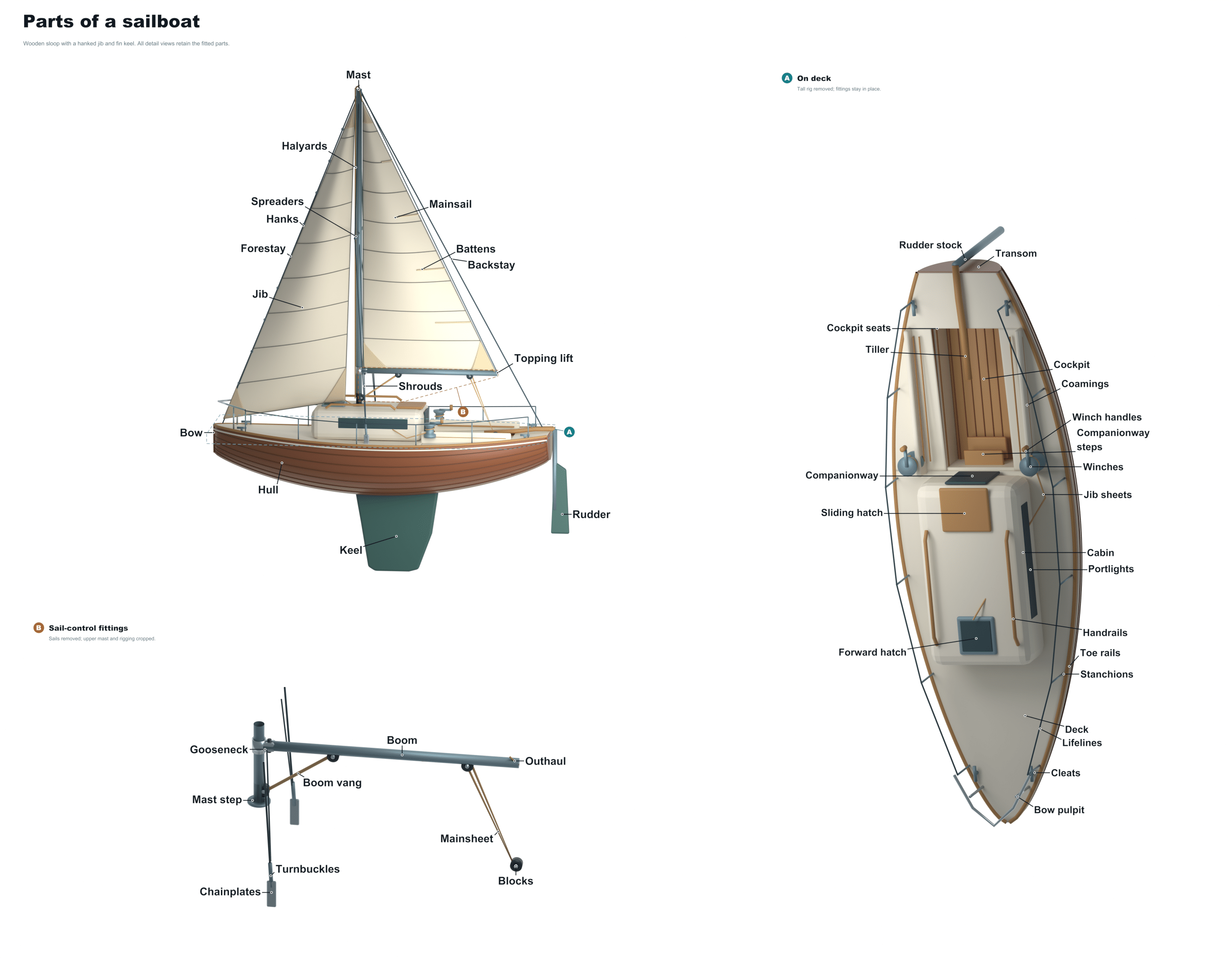
Sailboats are complicated machines designed to propel through the water using wind power. By learning about how they are built you’ll get an appreciation for what makes them work together. They deliver speed, stability and control. This diagram explains what these parts are called.
Every part, from the keel below the surface to the high mast, plays a role. It’s a good guide for identifying boat parts and knowing what they do. When on water it will give you a clearer picture of how boats behave.
Parts of a Sailboat
Hull
The hull is the main part of the boat. It is buoyant and floats in the water. Handling and speed is determined by hull design. Drag is lowered with a smoother hull. The boat glide better.
Deck
The deck rests on top of the hull. Crew stands on it. It must be sturdy underfoot. It is resistant to water damage. You walk on it to move around and adjust the sails.
Bow
The bow is the pointed end located in the front of the boat. It’s what breaks up waves.
Pulpit
A pulpit is a group of railings located at the front of the boat. Its purpose is to keep people from falling into water. The pulpit also holds up forestay. A forestay runs from the top of the mast down to the bow. The pulpit supports forestay.
Stanchion
A stanchion is a vertical post that holds up the lifeline. Lifelines are the lines on either side of the boat. They’re there to help keep crew members safe when they’re walking around the deck.
Mast
It is a sailboat mast. A mast is the main vertical pole that supports a sail. The part attached to the bottom of the mast is called the mast step. This is where the mast attaches to the hull and transfers the enormous forces from the sail into the hull structure.
Spreaders
Spreaders are horizontal arms attached to the mast. They slope the shrouds outwards. When pressured, they hold the mast true or straight.
Shrouds
Shrouds are wire lines running from the mast towards the sides of the hull. Their function is to keep the mast upright and prevent it from falling over on its side.
Stern
From the stern of the boat (back end) to the top of the mast. The backstay helps with tension on the mainsail as necessary and keeps the mast from bending forward.
Boom
Above the cockpit you’ll see the boom. This is a horizontal pole that holds the bottom edge of the mainsail. The gooseneck attaches the boom to the mast. This lets the boom pivot, or slide side to side. This pivot point is important for changing the angle of the sail.
Cockpit
The cockpit is the recessed area at the back of the boat. This is where the helmsman sits. Here are controls for sail handling and steering.
Tiller
Tiller: You’ll find it in the cockpit. This lever is connected to the rudder. With this lever, you can control the boat’s direction.
Rudder
A rudder is a vertical fin located below the water level at the stern. To guide the boat, it simply changes its direction. For efficient turning, proper rudder balance is very important. This helps avoid excessive drag.
Keel
Below the water line is the keel. Keels are heavy weights that hang off the underside of the hull. They provide stability against wind forces acting on the sails. With stronger winds and no keel, the boat tips over. In addition to providing stability, the keel creates hydrodynamic lift helping the boat move forward not sideways.
Jib
The wind catches the sails: The jib is the triangular sail ahead of the mast. It’s connected to the mast by the forestay up front and to the boom or deck out back. Behind the mast, there’s a bigger sail called the mainsail. These two, combined, form an airfoil that creates lift. By adjusting their shape, they alter the boat’s response to wind direction.
Mainsheet
Tension is managed by control lines, called sheets. The mainsheet runs along the end of the boom. When you pull on the mainsheet you are tightening the mainsail. The jib sheet adjusts the angle of the jib. Each sheet passes through blocks then fastens to the winch.
Winch
What’s a winch? A mechanical devise that multiplies your pulling power. It enables you to tighten heavy loads with less effort. To hoist and trim sails you crank the winch.
Traveler
Traveler; A track running along the mast or deck that lets you move the attachment point for the mainsheet from side to side. This adjusts the angle of the sail with respect to the wind. No need to grab the tiller. It gives very fine control of how much power or shape your sail has.
Cleat
A cleat is a small metal fixture on the deck. Used to temporarily secure ropes. When you’re not trimming lines, cleats keep them where you want them.
On the water, all these elements work together in a dynamic way. If the boat is sluggish, check the rudder angle and the sail trim. Is it leaning? Ease the mainsheet or adjust the traveler.
Hardware like stays, shrouds and other items should of been inspected regularly for wear and corrosion. Are cleats and winches wearing out? Knowing what each does makes you feel more confident while sailing.
Together they create a harmony that turns wind into progress.