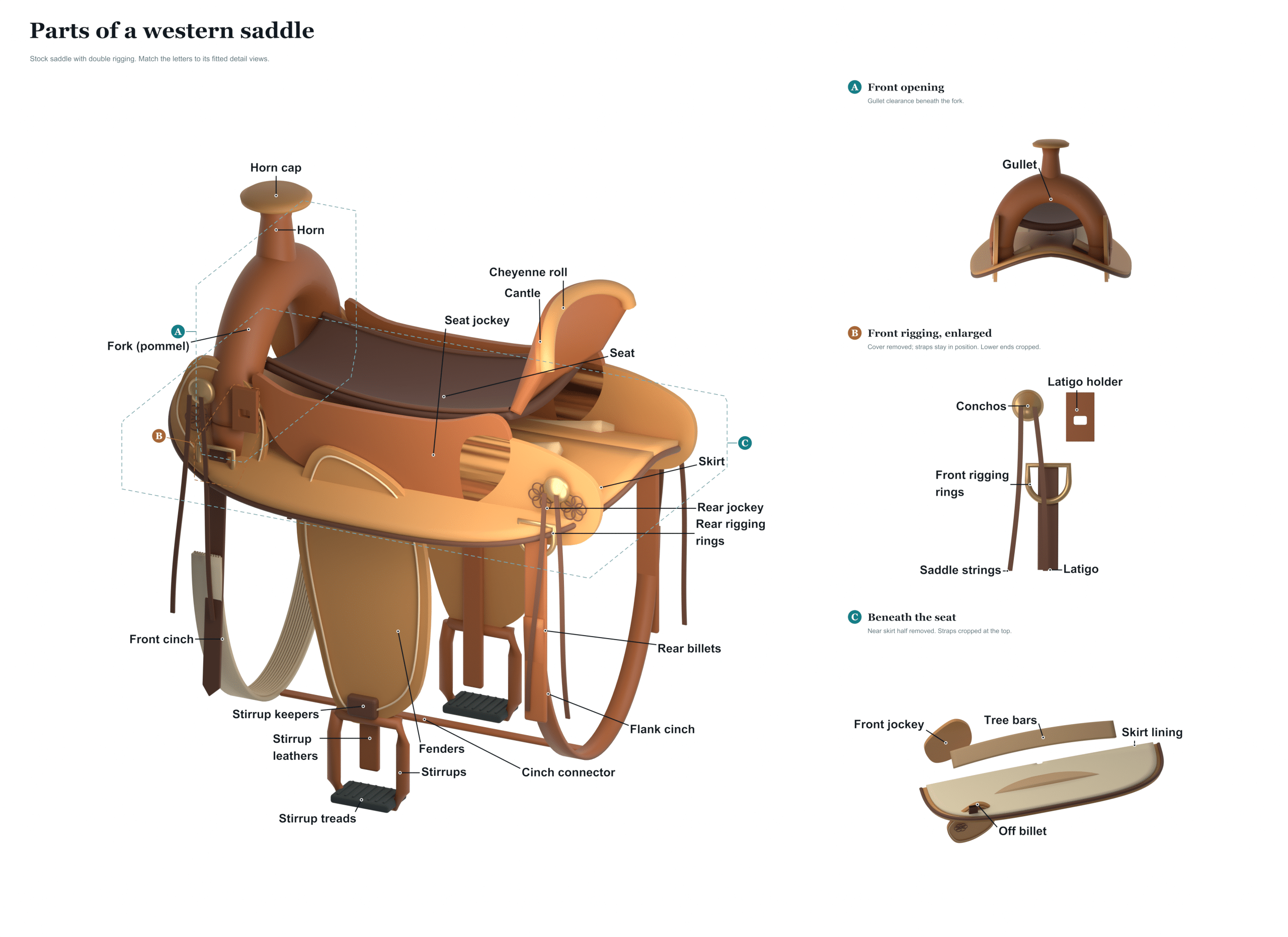
The saddle is used for Western riders. It holds you in place and distributes the weight on your horse’s back. Knowing the parts of a saddle is important if you want to care for one correcty. There are several parts that make up a western saddle, as seen in this illustration. Here is the list of what’s what with the saddle from front to back.
Parts of a Western Saddle
Horn
The horn rises from the pommel, which is the rounded part at the front of the saddle. This is the rounded part in the front. It surrounds the horn. The pommel is very strong and you want to make sure that there is no cracks. When you’re sitting on the horse, you can rest your hands on the pommel.
Pommel
Rising up from the pommel is the horn. The horn is used as a handle for roping cattle, though you should of never put all your body weight on it. Rather, it serves as an anchor point for mounting the saddle, providing stability. You will notice the horn protrudes off the side of the saddle towards the front.
Swell
Both sides of the pommel extend into the swell that shapes the tree. The curved bars holds the saddle up off the horse’s withers. By creating a comfortable space between the rider and the horse, this swell also makes for a smooth transition to the seat.
This is where your rear end sits while riding. It gives you a good platform to move around and work to communicate with the horse. The seat is often beautifully stitched, but its main job is to provide a stable platform that helps you stay balanced.
Cantle
At the rear end of the saddle is where the cantle rises to prevent you from sliding back on the horse. A higher cantle will give a beginner rider more security by supporting their lower back. In combination with the horn, it helps keep you in place while allowing freer movement if the cantle is lower.
Jockey
A little loop located near the back of the saddle called the jockey holds your stirrup leather when you’re not using it. That keeps the leather out of the way so it won’t get hung up on anything or swing around. This makes for an easier mount and more safety on the trail.
Skirt
A The skirt protects the horse’s back from pressure points, evens out the weight, and conceals the interior structure of the tree. Skirt tooling adds decorative touches to the skirt that make each saddle unique.
Back Housing
The back housing provide support for the cantle and the rear of the saddle. Holds the rear rigging firmly in place giving the saddle stability under load.
A concho is a metal disk applied on top of the leather. These serve not only as decoration but as a reinforcement at stitching points where strain is most likely to tear the leather. Durability- Back Housing and conchos can help enhance the durability and longevity of your saddle.
Cinch
This section explains how to adjust. The saddle’s fit also involves the cinch, which is a wide strap that wraps around the horse and is held by the metal rings called rigging dees. Double rigging on some saddles provides added security when riding at speed. The tighter the cinch is set, the more stable the saddle will be and these rings affect its stability as well. They should be secured.
Rigging
A cinch is part of the rigging, which are the straps and rings attaching the saddle to the horse’s back. These holds the saddle in place without sliding down. They also need to be checked for proper fit and rigging. Incorrect rigging can affect a horse’s comfort.
Fender
On the rider’s side is the fender, which is a large piece of leather that hangs down over the stirrup leather. It provides an extra layer of protection for the leather. It also keeps the dirt off the leather strap itself, so it lasts longer. The fender adds great protection. It extends the life of the stirrup leather and protects you from leg chafe. The name is Fender.
Stirrup Leather
This is connected via stirrup leather to the stirrup iron. This piece of leather also adjusts to fit your leg. It needs to be lubricated so it doesn’t snap. Check it to make sure there are no cracks that would make your ride unsafe.
Latigo
This is a latigo that runs through the rigging dee and buckles onto the cinch to let you tighten or loosen as needed. You want your latigo checked for wear because if it breaks, the saddle will move on the horse. The latigo is also critical for keeping the saddle in place.
Billet
That is called a billet. A billet is a loop on the cinch where the latigo ends. It’s like a buckle to hold the cinch in place. Therefore, it needs to stand up under tension. Billets can be made out of metal or tough leather. They need to be able to handle the load.
Stirrup
At the base of the leather is the stirrup, that’s the metal foot rest. It will help you stay in balance. An important safety note: A well-fitting stirrup keeps your foot secure so it doesn’t slip through. The stirrup helps you maintain balance and leverage.
How does a cinch work? A cinch wraps around the horse’s girth and holds the saddle in place. It should not be too tight, but snug. The cinch is the primary point of contact between the saddle and the horse. How the cinch is attached matters… And how comfortable it makes the horse. The cinch also plays into keeping the saddle stable and needs to accommodate air flow.
You can see where the other end of the cinch goes through the rear of the cinch (left side). That’s what holds the other end of the cinch still and keeps it from swinging with you when you turn or move the horse around. So it makes it more secure going over rough terrain. And that excess strap helps keep the saddle in place. It is good for trail riding. Not only will it make your ride more comfortable but safer than.
If you’re not sure that your saddle fits well, inspect the leather and be certain that the cinch is secure. Taking care of your tack ensures you are protecting your investment, and your own safety as well as the horses’.