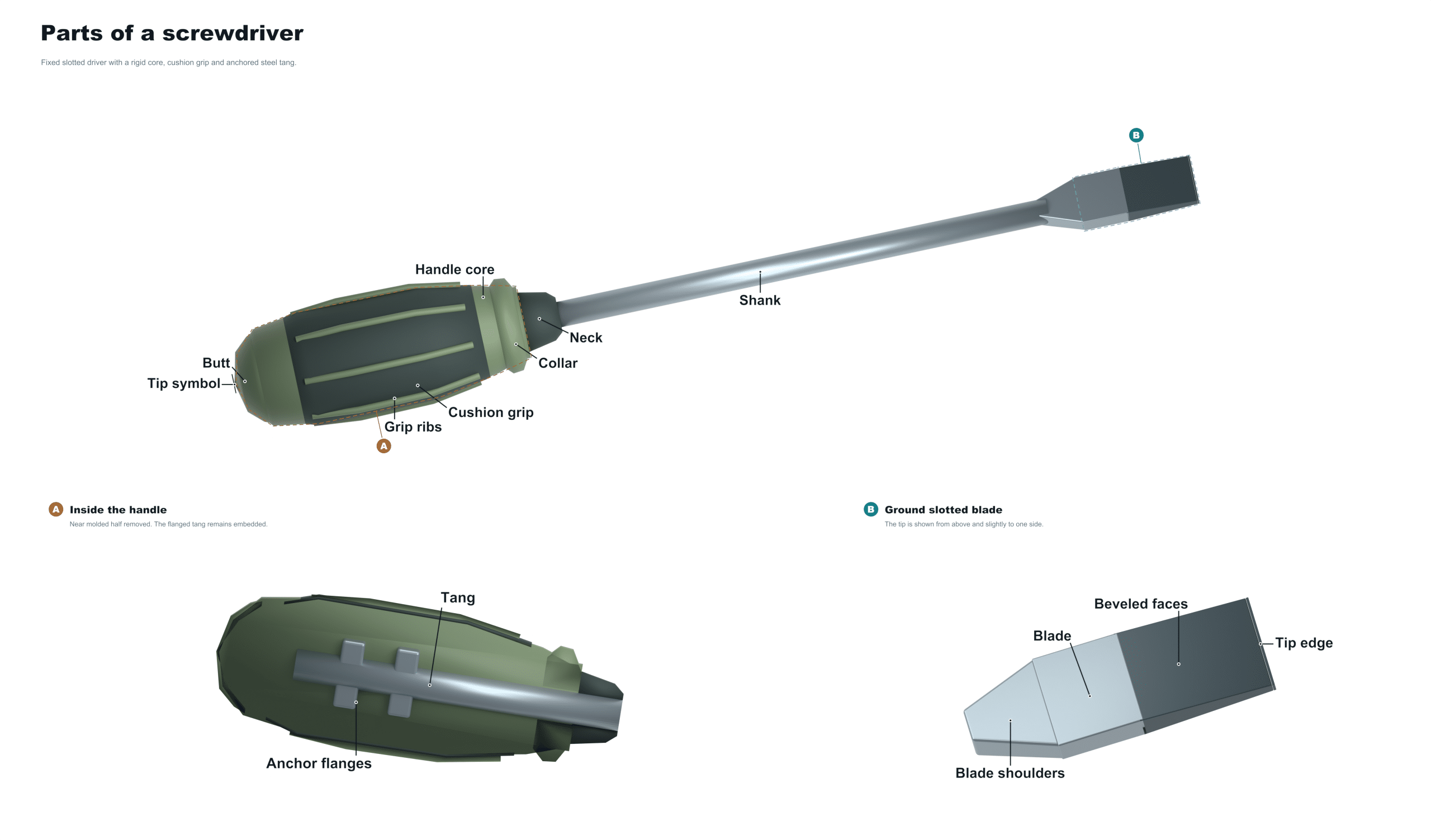
A screwdriver is an essential household and workshop tool. Why? Because you apply it to…screws! Screws is used for fastening things together or taking them apart for repairs. Seems simple enough, but this tool depends upon connected components that convert your hand strength into turning force. Knowing what they are can help you choose the right tool for the task. More importantly, knowing the parts enables you to care for the tool so it lasts longer.
The diagram above lays out the anatomy of a typical screwdriver. From there you can see how each part fits in to the whole. Knowing these names and their functions will help you understand this tool better.
The Parts of a Screwdriver
This is the part of the driver that actualy touches the screw head. It’s shaped to conform to the screw type (e.g. These include Phillips, flathead, and Torx. Because of this, the fit has to be exact… Otherwise the tip will slip out of the screw slot when you’re using it. When the tip gets wore down or rounded off, it can cause damage to the screw head and also make removal difficult. Make sure to check your tips periodically for any wear or deformation. This is especially true if you’ve been working on stripped screws or hardened metal.
Blade
The blade is the long metal part that extends from the handle to the tip. It gives you the length needed to get down into screw heads that have been driven deeply into a material. Or it gets you down under screws that are recessed beneath a surface. It needs to be rigid so it can resists the twisting action you put on it. That means it shouldn’t flex under load. Many times the shaft and the blade are made from the same piece of metal, but each has a different function. For heavy duty applications, a thicker blade tends to be preferred. For getting into tight spots, a thin blade works best.
Shaft
It is a shaft. The shaft is the part of the metal body we refer to as the cylinder between the handle and the working end. It’s the axle around which everything revolves. Generally speaking, the bigger the shaft diameter, the higher the torque capacity of the tool. In other words, a stout shaft means you’re able to transfer force from your hand through to the tip without too much twisting action. Typically, the shaft is made using a hardened steel, which helps resist shear stress when used in more demanding applications.
Handle
Where the handle meets the metal body is called the ferrule. Depending on the design, this part may be glued in or press-fitted into the handle housing. This is a critical place to have good structure. When the shank pulls out of the handle the tool feels like it is not stable. And it may fail under pressure. Knowing when the shank ends and the handle starts gives you clues as to the wear pattern. Wear means time to replace.
Between the metal shaft of your screwdriver and the handle is a thin metal collar or ring called the ferrule. The ferrule has both a functional and a visual role. Because it is at the point of connection between the two materials, it reinforces the join. To that end, the ferrule will help with keeping the handle material from cracking or splitting under pressure. On more traditional and older designs, the ferrule may serve a mechanical role as well by helping hold the handle onto the shaft. Cracks and separation here are a red flag that the handle is coming loose.
Grip
This is the main body section you grip and move around. Normally it’s constructed from some form of wood, rubber or plastic. This allows your hand to have a comfortabley place to rest. The purpose of this part is basically to translate the power from your wrist/arm into the shaft. When using the handle for a long time, a well designed one will reduce fatigue. Make sure it’s smooth with no rough spots or sharp edges. Any loose parts may be uncomfortable/harmful.
The grip is the part of the handle that has texture or contour to it. It’s there to provide maximum control and friction. So if you’re putting a lot of torque on it, it won’t slide out of your hand. Moddern handles incorporate ergonomic shapes and have used non slip materials to make them more comfortable for the user. Better grip means better control. This is especially true in tight quarters or when handling delicate electronics. Sometimes just wearing gloves can solve the problem of a slick or worn grip surface. And sometimes it calls for replacing the tool itself.
Butt End
On the other side of the handle from the tip is the butt end. The butt end is the closed end of the handle that completes the tool and frequently has a flat surface. You can strike the butt end with a hammer in specific chisel-style applications. It is also used as a counterbalance. It helps balance out the tool for even weight. On some more specialized screwdrivers, there are added features in the butt end such as a bit storage compartment or a magnet holder. Make sure it doesn’t wiggle around and is secure. It also adds to the overall stability of the tool.
Each piece is part of an integrated system. When you push on the handle it transmits its mechanical advantage through all of them. The force begins in your hand, travels up the grip, down the shaft and out the end of the tool. When it doesn’t feel right or seems inefficient or unstable, examine where those pieces connect. Is the ferrule tight? Does the tip have wear? Perhaps there is something wrong with the handle itself. Inspecting each component regularly keeps your screwdriver working well, but more importantly it keeps it a safe tool for your kit.